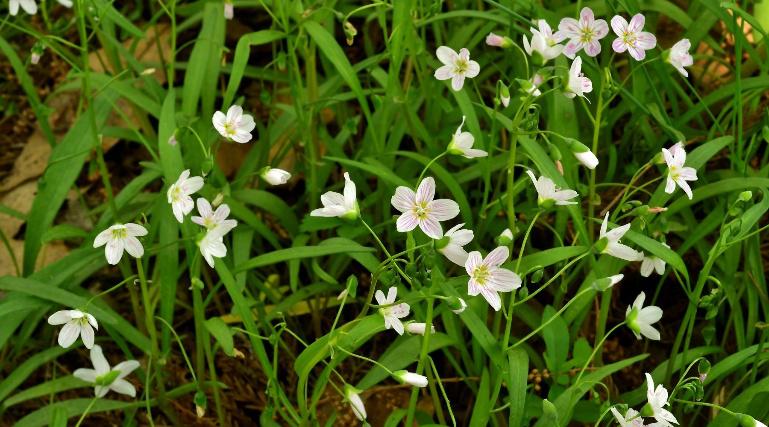

How often do we associate a relative, a friend or perhaps even a person we never actually knew with a plant? The plant need not be large or overly showy, but somehow the sight or mention of the plant brings forth thoughts of that person. For me it happens all the time and the memories provide a lot of joy as I garden! For some plants, the name may honor a person we have never met and it sparks thoughts about the person’s life or what they did to receive this honor. Such is the case of Claytonia virginica. It is an attractive spring ephemeral commonly called Spring Beauty (pictured above), but I always wondered – who was this person named Clayton?
Claytonia is a relatively small genus with about 33 species native to North and Central America, along with parts of Asia. It was originally placed in the Purslane Family or Portulacaceae, but in 2009 it was moved to the Montiaceae, often known as the Montia or Miner’s Lettuce Family. The rather unusual family name comes from Montia perfoliata, now named Claytonia perfoliata that is commonly called Miner’s Lettuce (leaf and flower are pictured above). This ‘lettuce’ is native to a large region of Western North America including California and was prepared and eaten much like conventional lettuce by miners during the days of the gold rush. A cool season plant that is easily grown in low or high tunnels for an early spring harvest, it has a somewhat oily consistency and a taste much like spinach. It is also rich in iron along with vitamin C and A and was primarily eaten to prevent outbreaks of scurvy.
As with so many plants, I long suspected Spring Beauty had an interesting story to tell about its namesake, although the plants were far from eager to divulge their tale! Claytonia was named in honor of John Clayton (1694/5-1773). Clayton’s father, who was also named John (1666-1737), served as the Attorney General for the colony of Virginia from 1713 until his death. Following in his father’s footsteps, the younger Clayton studied law and became the Clerk for the Gloucester County Court – a position he held from 1720 until his death. Clayton developed an interest in botany and plant exploration early in his career, possibly stemming from his friendship with the English naturalist Mark Catesby (1683-1749). Catesby visited colonial Virginia from 1712-1719 and at some point, met and befriended the young Clayton. After Catesby returned to England, they maintained their friendly correspondence. In 1734 Clayton sent a substantial number of dried specimens along with an accompanying manuscript describing the plants to Catesby, who in turn shared them the Dutch botanist Jan Gronovius (1690-1762). Overwhelmed by the sheer number of specimens, Gronovius sought the help of the Swedish botanist Carl Linnaeus (1707-1778) to help describe and author the plants. In a rather unpleasant turn of fate and long before Linnaeus finished reviewing the plants, Gronovius published Flora Virginica in 1739. It was partially based on Clayton’s manuscript and dried specimens, although Clayton was not notified nor asked for permission. To Gronovius’s credit, he did credit Clayton by naming Spring Beauty in his honor, which Linnaeus adopted when he formally named the plant Claytonia virginica in 1753. For Linnaeus, Clayton certainly advanced the understanding of Eastern North American plants since Clayton assembled around 700 plant specimens in his lifetime, many of which were the only plants available for Linnaeus to study, describe and name. The species epithet of virginica honors the colony where originally found.

Although it may have been found in the colony of Virginia, Claytonia virginica is native to a much larger region, stretching from Georgia to Nova Scotia, west to Texas and Ontario. Plants grow from a small corm which is edible and has a taste similar to that of Chestnuts. Come April, the plant produces 1 or 2 slender grass-like leaves at the base and usually 1 leaf along the flower stem. The leaves are roughly ¼” wide and stretch from 6-10” tall. From early to mid-April through May, abundant numbers of pink blossoms appear on a flower structure called a raceme, wherein individual flowers appear along a central stem. On average, each raceme produces 5-25 flowers. The ½-¾” diameter flowers consist of 2 cup-shaped sepals that split open to reveal 5 oblong petals, a whirl of 5 stamens and a central pistil with a tripartite style. A tripartite style splits at the tip into 3 prongs (as seen right), each tipped by a stigma. The petals are typically white with warm to pale pink stripes running the length of the petal. These stripes are thought to serve as nectar guides for visiting pollinators. The 5 stamens are tipped with bright pink anthers (easily seen in the image to the right) and only release pollen during the first day of bloom. In the subsequent days to follow, the anthers fade to light pink and the stamens reflex backwards so as not to interfere with the pollen receptive stigmas (as seen above in the flower on the right). Each flower is lightly scented and opens for upwards of 7 days. As a protective measure, flowers are only open during bright or sunny days and close both at night and on dark or rainy days.

Following bloom, a seed capsule forms within the two persistent sepals, with each capsule containing several seeds roughly 1 mm in diameter. Once ripe, the seed is mechanically ejected or shot from the capsule through a process known as explosive dehiscence. To further aid in moving the seed about, the seeds have a lipid rich appendage called an elaiosome. This appendage attracts ants who either move the seed back to their ‘home’ to feed the elaiosome to their larva or they consume it enroute, following which they dispose of the unharmed seed! Plants also spread through the production of small cormels or offsets of the corm, creating substantial colonies over time.

The flowers are rich in nectar and provide food for numerous bee and fly species. Following the lengthy bloom period, the foliage continues to lengthen to upwards of 8-12” tall before withering as the plants enter dormancy in June. When mixed amongst other spring and early summer bloomers, I have rarely noticed the foliage looking unattractive as it declines, although if it is planted unto itself, it can appear untidy. Frequently seen in woodlands throughout NJ, the plants also look great in the garden mixed with various sedges such as Carex appalachica, the blue flowered Jacob’s Ladder (Polemonium reptans), Twinleaf Jeffersonia (Jeffersonia diphylla) and various Trilliums. As seen in the image below, Claytonia provides a nice backdrop to Trillium sessile, commonly called Toadshade and the blue flowers of Jacob’s Ladder.

It’s spreading nature makes it a great plant for knitting compositions together. It also looks very attractive when interplanted with turf that is not cut until mid-May. It provides the lawn with a gorgeous pink glow as seen in the closing image at Rutgers Gardens! Hardy in zones 3-8, plants prefer light shade in humus rich soils with a slightly acidic pH, although they thrive in a variety of different soils.

For those gardeners looking for a slightly broader leafed species, you may wish to consider adding Claytonia lanceolata, the Western Spring Beauty to your garden. Hardy in zones 4-8, the flower is very similar to the Eastern species, although the foliage is broader and provides a coarser appearance. The flower petals also have a stronger pink blush. I had the opportunity to see it while hiking in the Rockies above the town of Vail, Colorado in early July (as seen in the image above). It was growing at elevations near 11,000 ft in meadows above the tree line. Snow from the past winter still remained in some areas although at lower latitudes, I suspect it would bloom during the traditional late April and May time period when snow has long vanished.

Plants need not be particularly large or boastfully showy to be a beautiful part of a garden. Spring Beauty is certainly a fine example of such a plant. Spreading abundantly where it is happy, the plant is wonderful for blending or tying garden areas together, readily growing in those nooks and crannies where it is difficult to plant. Although I clearly never knew John Clayton, I am thankful for his ardent efforts in searching and sharing of plants, particularly Spring Beauty. Hopefully I am not alone in remembering family, friends and perhaps even a few ‘friends’ never met while gardening!
By Bruce Crawford, Manager of Horticulture, Morris County Parks Commission
