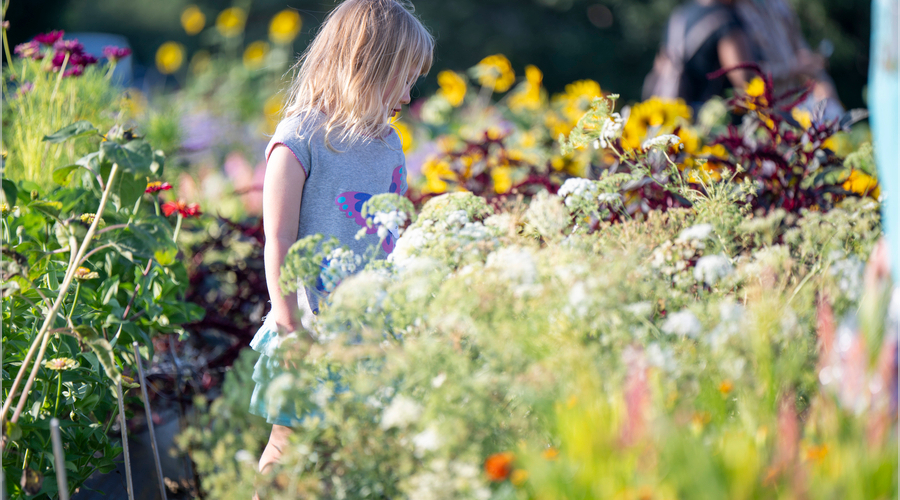

Colorful dahlias and delphiniums draw people in to buy the veggies, herbs and jams Berry Ridge Farms offers for sale at the Alexandria Farmers Market under the Big Ole statue every Saturday in season. But that is not the only reason Berry Ridge Farm sells cut flowers.
“One gentleman bought flowers for his sister-in-law’s birthday,” says Ron Branch, farmer. “She was in her 70s and told him nobody had ever given her flowers before. Flowers bring smiles to people’s faces.”
Ron and Ann Branch added flowers to their local foods mix when their twin sons wanted to grow them for a 4-H project. The boys bloomed into adults off the farm, but the flowers stayed planted.
Pretty with purpose
Flowers sustain pollinators, improving food crop yield. They can emit scents that turn pests away. Flowers play a role in tourism — sunflower fields make the perfect Minnesota roadtrip photo op, for example — and diversify a farm’s income.
Flowers even make an appearance in the culinary scene. Peppery petals may top a chef’s creation, sunflower seeds make tasty snacking, and many flowering plants make healthy seed oils.
“They sell,” says Robin Trott, Extension horticulture educator in Douglas County who also farms cut flowers with her husband Doug in Starbuck. “You do not need to be near a big city. People in small towns love a table-top arrangement or gift bouquet.”
For these reasons and more, University of Minnesota Extension research and education about flower production grew in 2024. Trott reached over 350 people through six Flower Farmer Stories webinars, covering topics from variety selection to marketing. Ron Branch was one of the growers sharing his story to help others learn if growing flowers might be for them.
Flour and flowers
Another guest on Trott’s Flower Farmer Stories series was Jenny Bredeken of Full Circle Farm in Starbuck. She returned to her family’s fifth-generation farm with her husband, Roscoe Fowler, after years living and baking in Hawaii. They now grow specialty grains.
Bredeken has fresh-milled flour in her blood, but flower farming “just kind of happened,” she says. “Maybe we should pick one thing, but there is a lot of value in doing something that brings you joy.”
Flowers, however, require a new skill set. Trott teaches how to plant in succession so that there is always something blooming, and how to use cooling technology to keep blooms fresh for the market and their final destination.
One mistake can have a silver lining. Bredeken once had a field of sunflowers “popping” all at once and had to put an ad on Facebook to have people come pick them. Suddenly, Full Circle Farm was a you-pick operation and Bredeken a freshly minted social media maven.
Flower subscriptions offer stable sales. Bredeken offers build-your-own-bouquet events and sells “bloom buckets” to La Ferme, a farm-to-table restaurant in Alexandria that puts a little floral spray on each table.
Trott provides a reality check for those considering this life. “Flowers alone may not be able to provide enough income or benefits, so like most farmers, you may be working hard on and off the farm.”
Research provides a rosy outlook
Mary Rogers, Extension horticultural entomologist, was just “flower curious” several years ago. But she wondered, “What would happen if fruit and vegetable growers integrated more flowering plants? Would this new venture benefit growers financially, help manage pests and increase pollinator habitat?”
R Roots Garden in north Minneapolis is one of the farms participating in Rogers’ study. On a warm summer evening in 2024, the Twin Cities Metro Growers Network, as well as other partners and neighbors, were convened there by Lia Spaniolo, Extension educator for urban agriculture and small farms, Hennepin County.
Rogers, along with R Roots grower Queen Frye and Spaniolo, presented to the community on cut-flower research and companion planting of flowers with vegetables to fend off pests.
Specific research questions remain, but the benefits for plant and soil health are apparent.
“You can see all this activity — it’s like rush hour for the bees,” says Frye, “And my greens are bigger, greener. My tomatoes are certainly larger than before. The flowers are here, I understand more about them and I will continue to include them.”
Grower highlight: R Roots Garden
R Roots Garden, the 2024 University of Minnesota Farm Family of the Year for Hennepin County, is operated by generational urban farmers. The group’s experience comes from the Boston Housing Projects of Dorchester, Mass., and Chicago, where they learned from family and community elders how to grow vegetable plants in urban spaces.
Through that inspiration, the growers started growing in north Minneapolis in 2019. Led by Queen Frye and Michael Kuykindall, R Roots Garden shares their knowledge of agriculture, provides access to locally grown food and uses the garden as a place to keep space for healing and arts.
By Catherine Dehdashti, University of Minnesota Extension
