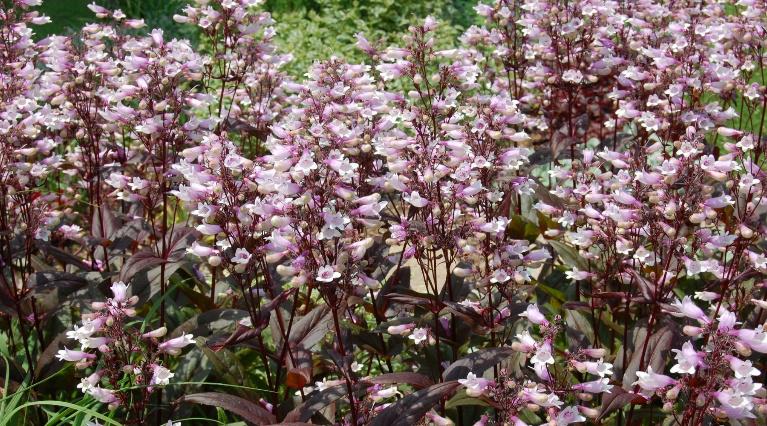

Imagine if plants could talk! We would certainly gather a far better understanding of why plants developed certain floral or seed characteristics, leaf shapes and even gain important insights into their preferences for various habitats. Penstemon digitalis, commonly known as Beardtongue comes to mind as a very promising candidate for striking up a conversation (‘Dark Towers’ is pictured above). Its tubular flowers open to bear a mysterious tongue-like appendage that for years was baffling to botanists yet something a conversation could easily have resolved!
Despite, or perhaps I should say thanks to this mysterious appendage, Penstemon has proven to be highly successful and is currently the largest genus endemic to North America. The genus contains approximately 240 species, although some references point to numbers closer to 270 species. It is presently found within the Plantaginaceae or Plantain Family and was only recently shifted from the Scrophulariaceae or Figwort (Snapdragon) Family in the early 2000’s. Penstemon digitalis is native to a broad range of North America, stretching from Maine to Georgia, west to South Dakota and Texas.
The genus name was first penned in 1748 by John Mitchell (1711-1768). Mitchell wore many diverse hats in his lifetime, varying from that of a botanist to a physician to even a cartographer! Born in Virginia, he traveled to Europe around the age of 11 to gain an education, which included a focus on the medicinal use of plants and a masters in botany. In 1731 he returned to Virginia where he established a practice as a physician, although he continued to botanize and advance his knowledge of plants native to the region. Much like Facebook groups of today, he sought out likeminded individuals and befriended John Clayton (1693-1773), the Clerk of the Gloucester County Courthouse and the English naturalist Peter Collinson (1694-1768). In 1741 he sent what he suspected to be 30 as yet ‘undiscovered’ genera of plants to Collinson who in turn shared them with the Swedish botanist Carl Linnaeus (1707-1778). Included in this shipment was most likely a plant of Penstemon laevigatus, but Mitchell simply described and named the plant Penstemon. Linnaeus disagreed with the name and in 1753 renamed it Chelone pentstemon, placing the plant in the genus for Turtleheads and adding an extra ‘t’ to the species name. Although, the flower does bear a resemblance to Chelone, confusion also revolved around the root of the name Penstemon. Beardtongue has 4 fertile stamens complete with pollen generating anthers and a fifth central sterile stamen or staminode, bearing an enlarged filament without an anther. In an unusual blend of Greek and Latin, Mitchell combined the Latin Pen or Paene for ‘almost’ or ‘nearly’ with the Greek Stamon for ‘thread’, pertaining to the male stamen. Combined, the name means ‘nearly a stamen’, a reference to the mysterious fifth and sterile stamen! Linnaeus thought he was referring to all five of the anthers, and he altered the name to reflect the Greek word for five or Penta. Finally, in 1763 the German botanist Casimir Christoph Schmidel (1718-1792) validly named and published the plant as Penstemon, although like Mitchell, he too failed to provide the name of the particular species being described.
One might question why Mitchell is not credited as being the author of this new genus, since he was the first to provide the name and description around 1741. According to the International Code of Botanical Nomenclature, only those names published in 1753 or thereafter can be considered as valid, since that year marks the publication by Linnaeus of Species Plantarum. Since Mitchell’s publication was prior to 1753 and Linnaeus published it under the genus Chelone, Schmidel happened to be the first author to validly publish the name Penstemon after 1753! If you are wondering who finally described and provided the species name of laevigatus meaning smooth, it was the Scottish botanist and Director of the Botanic Gardens at Kew, William Aiton (1731-1793) in 1789.

As an aside, although Mitchell proved to be a successful physician and botanist, he may be best known as a Cartographer. The 3½’ x 6’ map he crafted of North America in 1755 became the reference for the next 40 years and was the document used in establishing boundaries after the American Revolution between Britain and the very young United States. Also of interest, one of Mitchell’s final projects was developing a lake and greenhouses at Kew Gardens, which he oversaw from 1759-1761. Ironically, William Aiton who named Mitchell’s plant as Penstemon laevigatus became the Director of Kew in 1759, although the two had undoubtedly met in prior years from mutual acquaintances!
Penstemon digitalis was described in 1825 by the English botanist and physician John Sims (1749-1831). The species name comes from the Latin Digitus for finger, alluding to how the flowers loosely resemble the digits of a glove as seen below. Although Sims published the name and described the plant, he actually credited the English botanist and zoologist Thomas Nuttall (1786-1859) for being the first to name and describe the plant. Excluding the War of 1812 (1812-1815), Nuttall traveled throughout North and South America from 1810-1841, including a 9-year stint at Harvard University where he was the first professor of Botany. He found this species in Arkansas at some point prior to March of 1824 when he sent seeds with the name and description to a friend in England, who in turn shared the information with Sims.
Without doubt, the crafting of the name Penstemon digitalis was bumpy, yet the focus has always centered on the flower! The tubular flower is composed of 5 fused petals that create a trumpet-like shape ranging from ¾-1½” long. The distal or open end of the flower develops an upper and lower lip, a form that is botanically known as bilobate. The upper lip has 2 rounded lobes that project slightly upward while the lower lip has 3 rounded and slightly reflexed lobes. The lower lip also has a number of ⅛” long white hairs projecting upward at the flower’s entrance. Originating at the rear or proximal end of the floral tube are 2 pairs of long filaments that curl up and around opposite sides within the flower (easily seen in the image below), positioning the anthers at the top of the ‘tube’. To me, the filaments appear much like a floral ribcage. Projecting down the center of the flower is the enlarged sterile staminode that resembles a tongue about to rudely stick out of the ‘floral mouth’. The staminode is covered with short white and brown hairs, giving rise to the common name of Beardtongue. Similarly, projecting along the center and ‘roof’ of the flower is the female style and stigma. As the flower initially opens, they are not apparent but after a few days the style pushes outward and actually bends downward into the mouth of the flower, with the stigma looking much like a shower head.

Clearly a very complex flower and when Mitchell was initially describing Penstemon, he wrote Cui Usui or ‘For What Use’ when describing the sterile fifth stamen. From an evolutionary standpoint, the flower is thought to have been radially symmetric or ‘daisy-like’ with 5 petals and 5 stamens. As the more advanced bilobate and tubular flower developed, 4 of the stamens became symmetrically positioned on either side of the floral tube, with the nectaries located at the base of the filaments. This design allowed pollen grains to be deposited on the top of the pollinator as it made its way deep into the flower in search of the nectaries. The question of course was what was to become of the vestigial 5th stamen! As it turns out, locating this stamen down the center of the flower correlated with improved pollination. Its inflated size combined with its location and the hairs on both the staminode and lower lip impedes the ability of pollinators to exit the flower, thus increasing their overall visitation time. The longer visit correlates with better pollination and the positioning of the sterile fifth stamen suddenly makes perfect sense! In addition and similar to many flowers, Penstemon exhibits the process of protandry whereby the anthers proceed to ripen and shed pollen before the stigma becomes receptive to pollen, thereby preventing self-pollination. This process is aided by the length and shape of the female style. As the stigma becomes receptive to pollen, the style lengthens and bends downward, allowing the stigma to easily come in contact with pollen grains deposited on the back of pollinators from visits to previous flowers. Absolutely brilliant!

Although a bit less dramatic, the foliage is also very noteworthy! Plants have a rosette of evergreen, lance-shaped leaves that persist throughout the winter, although they become tattered by March. Come April, new foliage begins to appear followed in May by numerous floral panicles arising from the base. The lower ½ of the floral spike is clothed with whirls of 2-3 clasping, lance shaped leaves at each node. The upper portion of the spike develops numerous opposite branches, with each branch displaying a cluster of individual floral buds (as seen above). The overall floral structure is called a panicle or branched raceme and varies from 2-5’ in height. Come fall, the foliage develops strong orange and deep red hues (as seen below), while the flowers transition into ¼” long, tear-drop shaped capsules containing numerous small seeds. The clusters of capsules provide a subtle yet attractive touch during autumn and winter, especially when seen amongst ornamental grasses.

As with most garden worthy perennials, there are a number of good selections on the market where the primary focus is not on the flower but the foliage. ‘Husker Red’, ‘Dark Towers’ and ‘Blackbeard’ are three very good selections with deep red to purple foliage that provide interest for the garden well beyond the late spring and early summer floral displays. All of these dark red forms produce seedlings with varying intensities of red foliage. There are also equally attractive green foliaged selections available with pink to lavender flowers.

Typical to most species of Penstemon, plants require full sun and well-drained soils to perform at their best. They will perform admirably in silty, more poorly drained soils, although they will not tolerate standing water for any period of time. Hardy in zones 3-8, plants are also tolerant of pH levels from neutral to acidic. Plants look great in a mixed border with a backdrop of purple foliaged shrubs such as Calycanthus floridus ‘Burgundy Spice’ (as seen below) or mixed with perennials such as the early blooming Beebalm species (Monarda bradburiana)or Compact False Indigo (Baptisia australis var. minor). The purple foliaged forms look great with bold red blooms, such as Lilies and Indian Pink (Spigelia marilandica), pictured in the closing image. As noted earlier, they mix well with ornamental grasses such as Feather Reed Grass (Calamagrostis x acutiflora ‘Karl Foerster’) and Little Blue Stem (Schizachyrium scoparium).

Just think what else we could learn from Penstemon digitalis if its bearded tongue actually enabled it to talk. Of course, there would also be the drawback of hearing the many complaints about their neighbors, disputes over pollinators, irritation over poor weather conditions or discussions about our less than perfect attempts at proper cultivation. Perhaps it is all for the best that Beardtongue remains a beautiful yet silent sentinel of our gardens!

By Bruce Crawford, Manager of Horticulture, Morris County Park Commission
