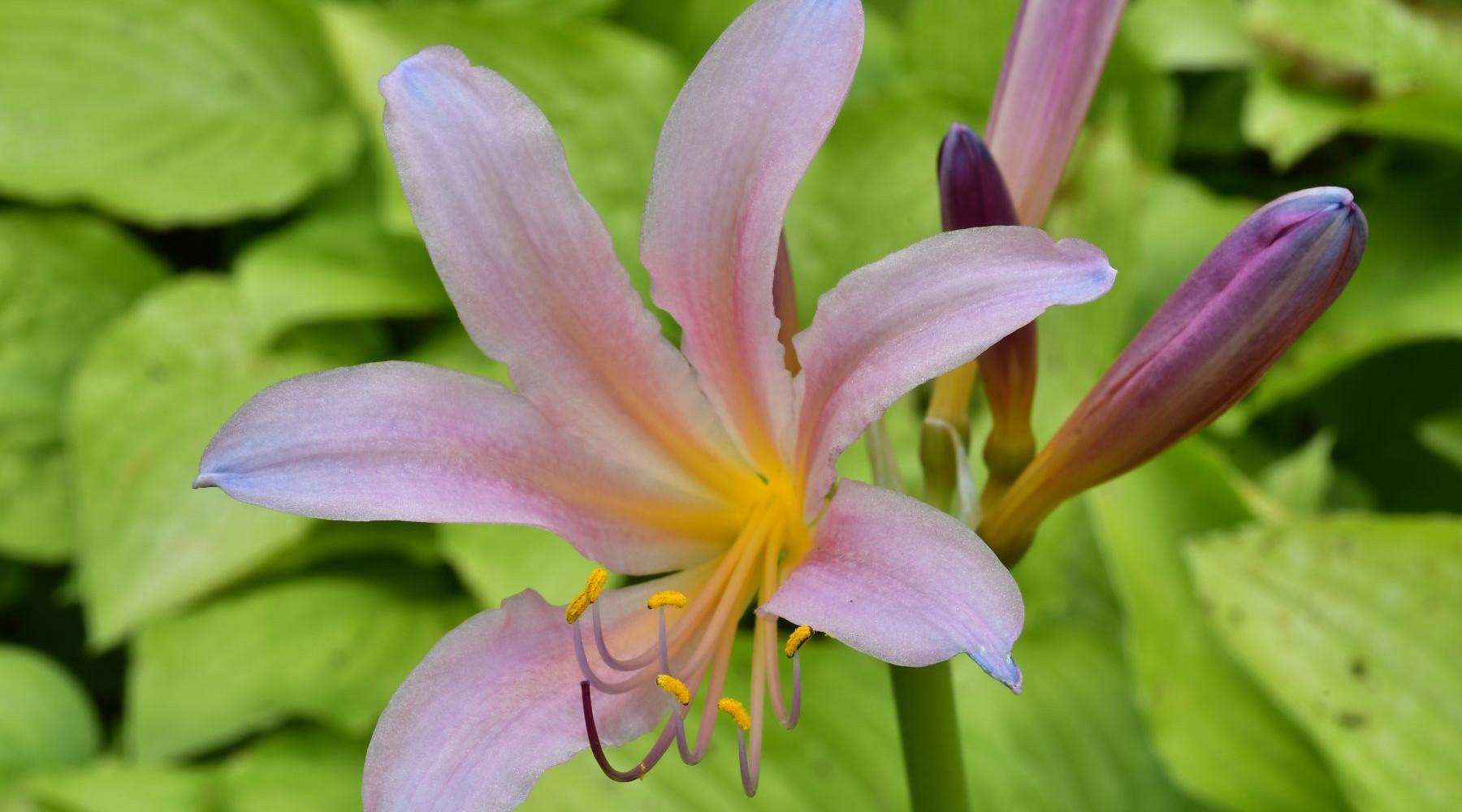

I have long concluded my worldly knowledge is woefully insufficient for crafting botanical names! Creating these names requires a comprehension of Latin and Greek languages, often blended with an understanding of mythological tales from around the world. This depth of knowledge is no more apparent than in the naming of Lycoris squamigera, a bulb commonly called Surprise Lily or Naked Lady. Displaying beautiful clusters of pink flowers from July into August, long after the robust spring foliage has withered (as seen below), I never would have guessed the genus name was inspired by a tragic Chinese myth of passion, a beautiful Roman mistress and poetry of love lost. Talk about a name briming with surprises!

Lycoris is a member of the Amaryllidaceae or Amaryllis family, with 13-20 species stretching from Japan and Korea west to Afghanistan and eastern Iran. The plants were originally placed within the genus Amaryllis by the French botanist Charles Louis L’Héritier de Brutelle (1746-1800). In 1788, Brutelle named and described Amaryllis radiata, a plant native to Asia that is now known as Lycoris radiata. It bears the common name of Spider Lily owing to the numerous long stamens. The genus name of Amaryllis was first penned in 1753 by the Swedish botanist Carl Linnaeus (1707-1778), who adopted it from the classic poetry of the Roman poet Publius Vergilius Maro (70-19BC), who was better known as Virgil. Amaryllis was the name of an attractive young shepherdess found in Virgil’s works and comes from the Greek Amarysso for ‘to sparkle’.
The plant was reclassified as Lycoris radiata in 1820 by the British botanist, botanical illustrator, poet and clergyman William Herbert (1778-1847). Although he was noted for being a very kind pastor who delivered rather dry sermons, it was his passion for poetry and the Amaryllis family for which he is best remembered. In fact, in 1837 he published a 537-page book on the Amaryllidaceae, as he worked to tease apart and identify the various genera found within this family, such as Lycoris. Lycoris radiata is hardy in zones 6-10, but needs to be sited carefully in northern regions to protect its evergreen foliage and to ensure flowering the following summer. The plant is revered in Japan and China for its blood red, trumpet-like flowers where it was often planted on graves in the hopes that its poisonous alkaloids would prevent animals from digging up loved ones who had recently passed. The plant was also the subject of a Chinese myth involving a tragic love affair between two ‘elves’ named Mañju and Saka. The sun goddess Amaterasu instructed the elf Mañju to protect the flowers and Saka the foliage with the lone caveat that they were never to meet. Naturally, curiosity got the better of them and they planned a meeting whereupon they fell madly in love at first sight. As is true of all great tragedies, they were punished for disobeying Amaterasu’s command. To prevent them from ever meeting again, the foliage was to appear only in spring while the leafless flower stems to appear in August!
This myth may not explain the name Lycoris, but it provided the needed inspiration for Herbert to recall the pages of ancient Roman poetry. Lycoris, as it turns out, was the alias or pseudonym of a young actress, dancer and mime named Volumnia Cytheris. Most likely of Greek decent, Cytheris was the freed slave of a Roman aristocrat who lived in the first century BC. This access to aristocracy allowed her to became highly educated, enabling her to read and sing the poetry of Virgil to great acclaim! She was also touted as an actress and a mime, perhaps a profession better known today as an exotic dancer. She was also romantically involved with Mark Antony (83-30 BC), Marcus Junius Brutus (85-42 BC) and the Roman poet and politician Gaius Cornelius Gallus (70-26 BC). It was Gallus who was so smitten by Cytheris that he authored 4 books of poetry in recognition of her beauty, providing her with the name of Lycoris for the poetic verses. The last book was written around 40 BC, following the decision by Cytheris to find another lover. The book focused on his pining over love lost. It is thought the similarities between the loss of a lover for Gallus and the fate of Mañju and Saka was the inspiration needed for Herbert to honor her with the naming of this new genus!
The species of Lycoris squamigera was named many years later by the Russian botanist Carl Johann Maximowicz (1827-1891) in 1885. He explored much of Southeastern Asia and Japan and ultimately became Director of the Saint Petersburg Botanic Garden in 1869. The species is thought to be native to SE China, Korea and Japan while the species epithet is from the Latin Squamigera meaning scaly or bearing scales. Indeed, the small scales present on the flowers provide a shiny or sparkling effect, as seen in the lower tepals. More recently it was revealed this ‘species’ is actually a sterile triploid and is most likely a cross between two Chinese species – Lycoris longituba and Lycoris springeri. The plant should be written as Lycoris x squamigera, but has been accepted as a species status.

The plant was eventually brought to the US by the physician George Rogers Hall (1820-1899) who became better known as a plant and art importer rather than a physician. Perhaps best recognized for introducing Hall’s Japanese Honeysuckle, Hall did introduce many garden worthy plants and in 1861 Lycoris squamigera was included in a large shipment of plants gifted to the naturalist and historian Francis Parkman Jr. (1823-1893). Lycoris grows from a true bulb, consisting of layers of modified leaves typical of an onion when cut open. The bulbs are best planted in the early fall and it often takes several years for the bulbs to acclimate to their new home. The foliage appears in late February or March, depending upon the year. The grayish green leaves strongly resemble that of Daffodils, although they ultimately grow taller, reaching 20-24” tall by ¾-1” wide (as pictured above). The foliage withers by early to mid-June and is long forgotten when the flower buds rapidly shoot skywards atop stout, 18-24” naked stems that inspired the common names of Surprise Lily and Naked Lady. The flowers appear in an umbel of up to 12 trumpet shaped flowers with each flower around 3” in diameter. The flowers consist of 6 tepals, 6 male stamens and one very prominent female style and stigma. When the outer protective calyx and the petals appear identical, they are called tepals. The flowers are a beautiful deep pink in color, although it is not uncommon for the tips of the bud and open tepals to have a prominent blush of blue. The flowers are often at their peak in Morris County NJ by late July through mid-August. By comparison, at Chanticleer Garden in Wayne PA, the flowers often remain attractive into late August. Oddly, I have noticed plants in the shade often come into bloom first!

Recently, we dug and moved a number of bulbs at Willowwood Arboretum. We were looking to add some color to a lawn panel that is not cut in mid-July through October – an inspiration from the display at Chanticleer. We dug the bulbs immediately after bloom in the hopes the plants were dormant, although the roots were still actively growing. The bulbs are oblong and large, upwards of 2-3” long and strongly resemble those of a Daffodil. Bulbs of this size should be planted 6” deep, although we noticed that certain masses of long-established bulbs were literally at the surface and had been blooming strongly for years! Once moved, we also noticed it took 2-3 years for the plants to reestablish and start to bloom once again. At George Rogers Hall’s home and personal garden in Bristol Rhode Island, his grandson noted in an article published in Arnoldia (April 1923) that the bulbs had naturalized throughout his garden. Presumably they were spread either by human hands or possibly by various animals since the plants do not reproduce by seed! As mentioned, all parts of the plant, including the bulbs are poisonous due to the presence of the alkaloid Lycorine, explaining why the bulb is not eaten if moved about by animals. It also explains why Lycoris radiata was planted atop graves in Asia to prevent disturbance! To the gardener’s delight, the alkaloid also serves to make the plant deer resistant!


Once established, Lycoris is amazingly easy to grow. Successful in both full sun and light shade, it looks best where the naked stems can emerge from another, lower growing groundcover such as Hosta, various ferns, sedges or even uncut turfgrass! The pink flowers are also ideal for pairing with purple foliaged shrubs, such as Calycanthus floridus ‘Burgundy Spice’ (Carolina Allspice) or the various purple forms of Physocarpus opulifolius (Ninebark). Plants are hardy in zones 5-9 and prefer moist yet well-drained soils with a slightly acidic to neutral pH.

Lycoris is certainly a plant of many surprises, especially when the vibrant pink flowers virtually appear out of nowhere in late summer! The complex origin of its name is also a surprise I never would have guessed nor have I the knowledge to create! Fortunately, William Herbert’s knowledge of poetry, mythology and botany bore all the necessary ingredients for crafting such a unique name for a wonderous group of plants. Hopefully, Lycoris squamigera will provide years of intrigue and surprise for your garden!
By Bruce Crawford, Manager of Horticulture, Morris County Parks Commission
