
Believe it or not grass is actually one of America’s most irrigated crops covering around 40 million acres of land within the U.S. Most of this acreage is in the form of home lawns and other green spaces. As the lawncare season is starting up across the country consider the development of the lawn and America’s infatuation with it.
America’s adoption of the lawn as part of a person’s property is a relatively recent development dating back to the late 19th century. The lawn’s origins, however, stretch back further. In Medieval European times many towns had grassy spaces for recreation and livestock grazing called the town commons or village green. The space immediately around castles was often cleared for better visibility. When vegetation grew back it created natural lawns around the fortress. There appear to be instances of turf growing in other parts of the world in that time period too as a Japanese gardening book published in 1159 contains the earliest-known description of sodding.
By the 1600s turfgrass cultivation was happening to produce grass for recreational purposes and for the estates of wealthy European nobility and aristocrats. The lawn became an important feature for the large country estates of nobility in parts of Europe in the 18th century. At first, French-style formal gardens were popular and focused on highly stylized, geometric patterns in their landscapes and plant designs. Within these gardens were areas of trimmed turf called tapis verts, meaning “green carpet.” Later the English-style garden took over featuring a more natural look with artificially made hills, ponds, and streams that blended into a landscape. To connect these features larger swaths of turfgrass were needed.
Regardless of style, a lawn was something that could only be enjoyed by wealthier individuals because of its cost to install and maintain. While animals like cattle and sheep were used to “mow” the grass on many parts of an estate, areas closer to the home had to be worked by hand with a team of men using scythes to cut the grass. To many, the lawn was a symbol of prosperity.
The establishment of turfgrass in America was a long process that began in the colonial era. When Europeans started colonies in North America they brought cattle and other grazing animals with them. However, pasture grasses were not native to the East Coast which instead had annual grasses like rye, broomstraw, and marsh grass. These grasses were not as nutritional as those that were grown in Europe and it did not take long for animals to consume much of them. To improve pasture and save livestock colonies began importing grass and clover seed mixtures from Europe. Introduced grass species eventually became naturalized in areas of North America. Many of today’s well-known turfgrass varieties like Kentucky bluegrass, Bermudagrass, and Guinea grass to name a few originated in other parts of the world and were implemented to support livestock needs. These imports also spread common weeds like dandelions and plantains.
Similar to Europe, in the early years of the United States only very wealthy individuals could have lawns on their property. George Washington’s Mount Vernon and Thomas Jefferson’s Monticello were two estates that did have lawns installed as both sought to emulate the styles of the English country manor on their properties. Spaces around houses were typically kept as packed dirt or grew a combination of native grasses, weeds, and wildflowers. These areas were sometimes kept barren on purpose for pest prevention. Architectural trends in early America also deterred the installation of lawns as houses were situated closer to streets and roads than they are today with little room in the front, but space behind the home for private gardens.
In the late 19th century the appeal of lawns began to grow amongst the American populace. In the mid-1800s the public park movement occurred which sought to incorporate green spaces in urban and suburban areas. Influential landscape designers like Andrew Jackson Downing and Frank Law Olmstead helped introduce ways for grass to beautify home properties and public areas. Olmstead’s designs in particular introduced the idea of moving homes farther back from streets and building them in the center of a lot which would be surrounded by grass. This was done to give the impression of a neighborhood built on one large connected lawn, melding private and public spaces. This style would become uniquely American.
The economic prosperity that occurred after the Civil War gave many wealthy and middle-class citizens the funding to invest in a lawn for the first time. Improvements in travel from trains and later automobiles also meant more people were moving farther distances and seeing more homes in their travels. This increase in passersby led to the trend of beautifying homes and yards. Keeping a well-ordered lawn was increasingly seen as a way to liven a property and portray a good image to neighbors or travelers observing from a distance.
Lawn games like croquet, tennis, badminton, and others became increasingly popular in the late 1800s making grassy parks and backyards a preferred location for socializing, recreation, and relaxation. The game of golf also came to the U.S. in 1888. As golf’s popularity grew in the following decades, so did Americans’ desire to have the lush, trimmed green grass of golf courses at their own homes. After demonstrating lawn cultivation for the first time at the 1876 Philadelphia Centennial Exhibition, the USDA formed the Botanical Division for the research of turfgrass to help meet this growing demand.
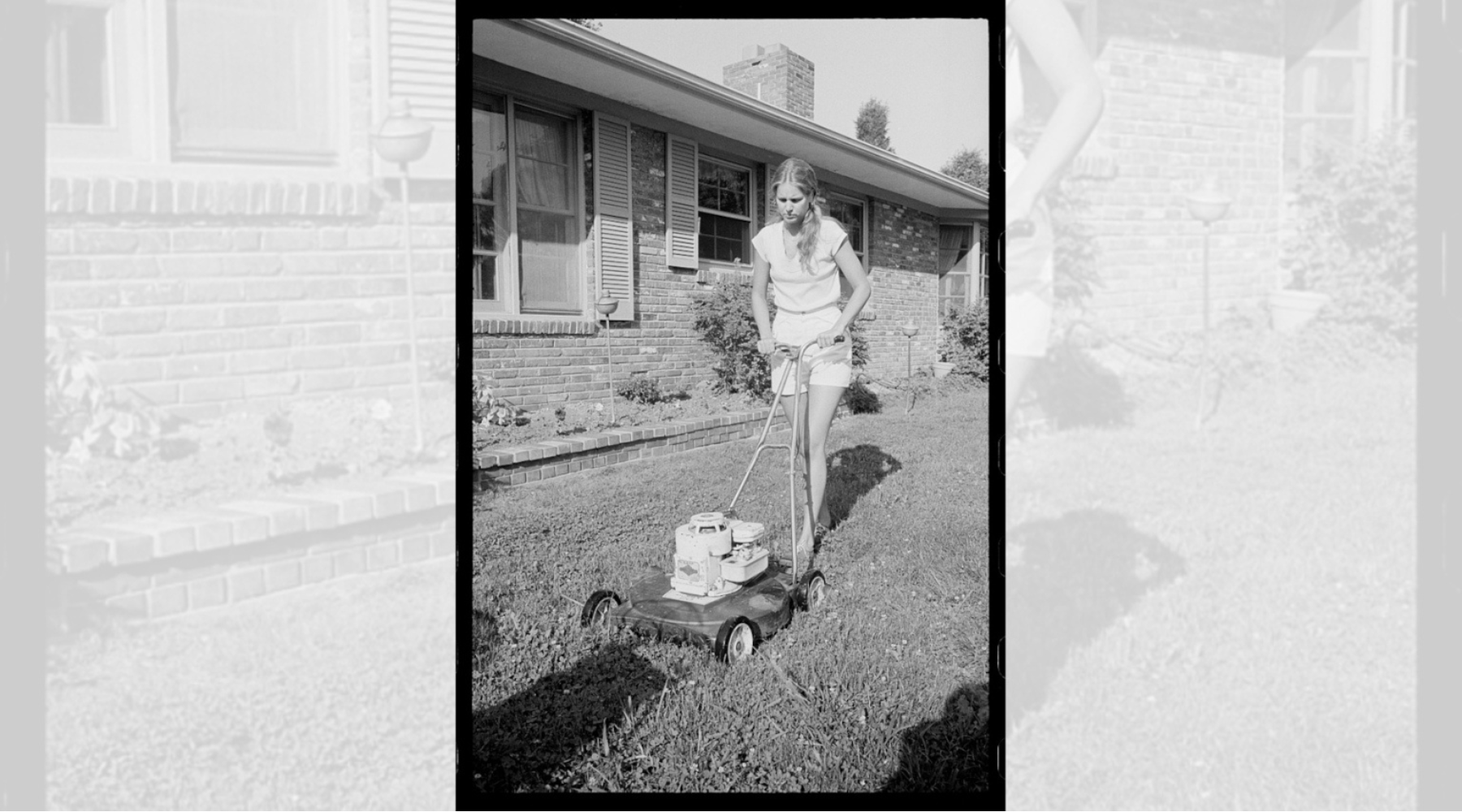
As lawn installations increased, so did the need for lawn maintenance equipment. Most notable is the lawn mower which was first invented in 1830 by the English engineer Edwin Budding. The idea came to Budding after viewing a cylindrical cloth cutting machine in a textile mill. Made of cast iron the mower involved blades moving around a cylindrical reel and was quite heavy requiring two people to operate, one pushing from behind and one pulling from the front. About ten years after its invention a horse-drawn version of the machine was introduced. Mowers became lighter and simpler over time and in 1870 a man named Elwood McGuire from Richmond, Indiana patented a lightweight push mower which became very popular in the U.S. In 1902 the first gas-powered mower was introduced by the British company JR & A Ransome making the task of lawn mowing easier.
The keeping of a lawn became firmly established after World War II. Post-war America experienced a house-building boom fueled by loans provided by the Serviceman’s Readjustment Act, or G.I. Bill. Grass lawns and the maintenance of them became a standard, sometimes mandatory, facet of homes built in the new suburban communities that were formed in the 1950s and 1960s. Also by this time, the 40-hour work week became required in most industries allowing residents more time to keep their yards looking good.
Homeowners during this time benefitted from continual developments in the turfgrass industry. In the 1910s the USDA and U.S. Golf Association (USGA) teamed up to help fund and carry out turfgrass research to improve grass varieties. In 1920 the USGA formed the Green Section which provides funds for turfgrass research at universities and golf course management consultation and education. The Green Section still operates today and through the years has helped improve turfgrass varieties that are used on the links, around the home, and native grass varieties too. Some highlights include the development of “Penncross” bentgrass and “Tifway” bermudagrass in the 1950s and more cold-tolerant bermudagrass varieties in the 1970s. Researchers across the country continue to study the qualities of grasses to breed varieties for a host of uses such as sustainability, hardiness, and durability to name a few.
The first rotary power lawn mowers were built in the 1930s cutting grass horizontally to the lawn. This design is used in most mowers today. The Toro company became a go-to brand for many homeowners in the 1940s and 1950s. By the 1960s some manufacturers began introducing “zero-turn” technologies to their mowers making for more precise yard work. The 1950s also saw an increase in the use of inputs like fertilizer and herbicides to improve their lawns and suppress weeds.
Nowadays, the lawn has become a fixed part of the American landscape. The average American spends around $500 a year on lawn care and gardening, and the U.S. landscaping industry is valued at over $100 billion. The lawn has also become a part of American culture and in many countries around the world is viewed as a distinctly “American” feature. Though looks can be deceiving a tidy yard is often viewed as a benchmark of a homeowner’s management, while an unkempt lawn could raise eyebrows. Images of the backyard barbeque, the teenager cutting grass to earn some cash in the summer, the dad who spends maybe too much time perfecting the yard, and the old man who yells “Get off my lawn!” to some pesky whippersnappers all point to how the lawn has become synonymous with home ownership and everyday American life.
Chandler Hansen grew up and lives in Easton, NY. He is a graduate of Gordon College where he earned a bachelor’s degree in History. He served as a writer and editor for Morning Ag Clips.
By Chandler Hansen
