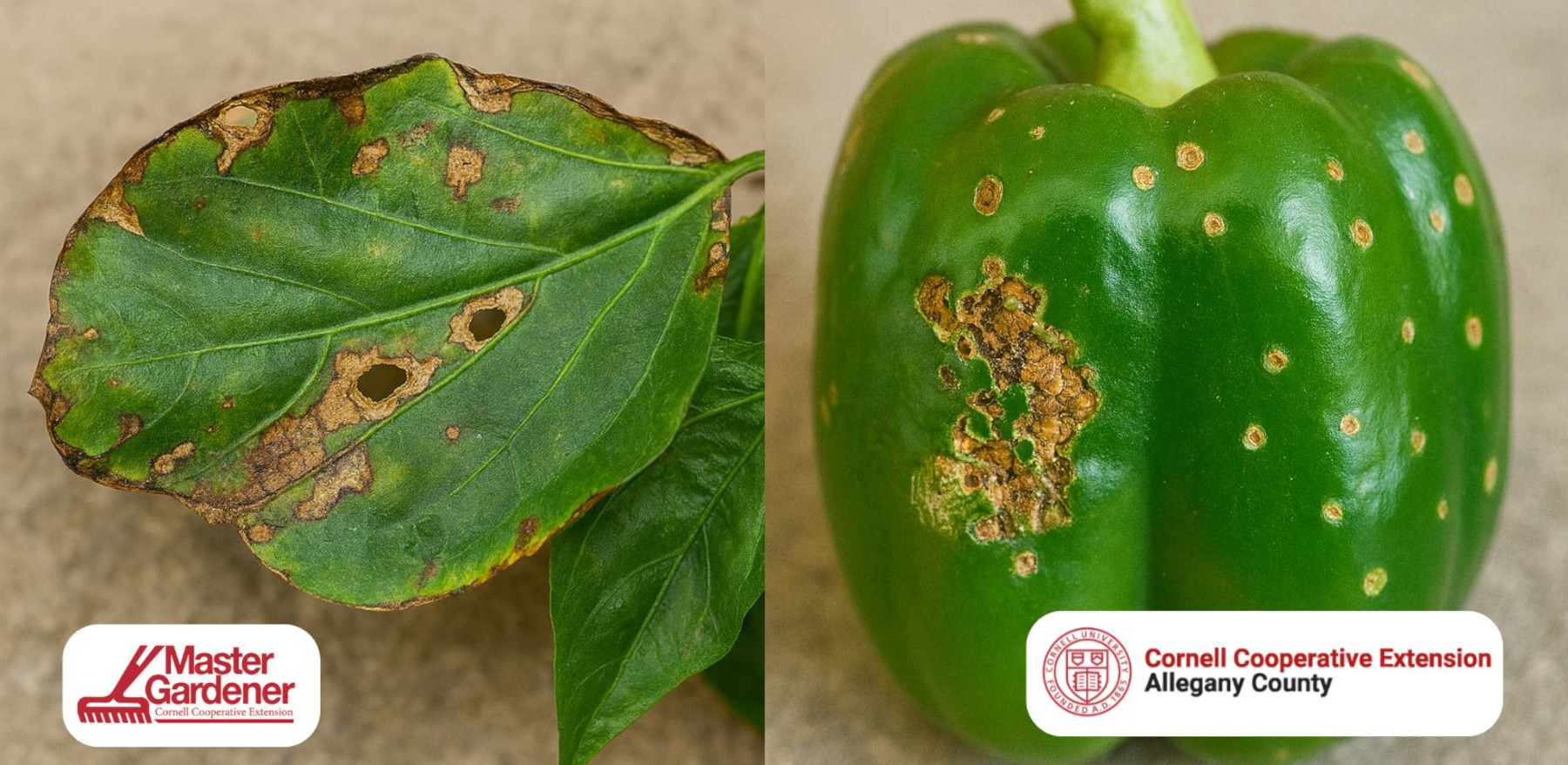

As mid-July brings warm, humid, and stormy weather to Allegany County and surrounding areas, local gardeners may notice troubling symptoms on their pepper plants, dark spots, yellow halos, or even wilting leaves. These are signs of bacterial leaf spot (BLS), a common and potentially serious disease in peppers (and tomatoes) caused by the bacterium Xanthomonas campestris.
This disease thrives in wet conditions and spreads easily through splashing rain or overhead watering. If left untreated, it can lead to leaf drop, poor fruit development, and even plant death.
Treatment depends on how severe the outbreak is. For mild cases (a few spots on lower leaves), gardeners are encouraged to remove affected leaves and use organic treatments such as copper soap or biological sprays containing Bacillus subtilis. Avoiding overhead watering and improving air circulation are also key.
For moderate infections, a combination of organic and chemical treatments is more effective. Apply copper-based sprays promptly, alternate with Bacillus subtilis, and take care to sanitize tools and avoid spraying during extreme heat to prevent chemical burn, known as phytotoxicity.
In more advanced cases where many leaves are affected and new growth is at risk; strong chemical control is necessary. This includes using copper hydroxide or sulfate sprays and, if needed, adding streptomycin products. Infected plant debris should be removed and discarded, never composted.
To prevent this disease in future seasons, experts recommend planting resistant pepper varieties labeled with resistance genes like Bs1, Bs2, or Bs3 (often listed as X3R). Reliable options include bell peppers like ‘Aristotle X3R’ and ‘Paladin,’ and hot types like ‘Baron’ and ‘Anaheim X3R.’
Combining resistant varieties with proper garden hygiene, drip irrigation, crop rotation, and early monitoring offers the best defense against bacterial leaf spot. Gardeners who need help identifying this disease or other plant issues are encouraged to contact their local Extension office, we’re always happy to help! To read the full article, visit https://allegany.cce.cornell.edu/gardening/pest-management/bacterial-leaf-spot-in-peppers-how-to-identify-treat-and-prevent-it
By Cristian Acosta, Ag. Educator Cornell Cooperative Extension Allegany County
