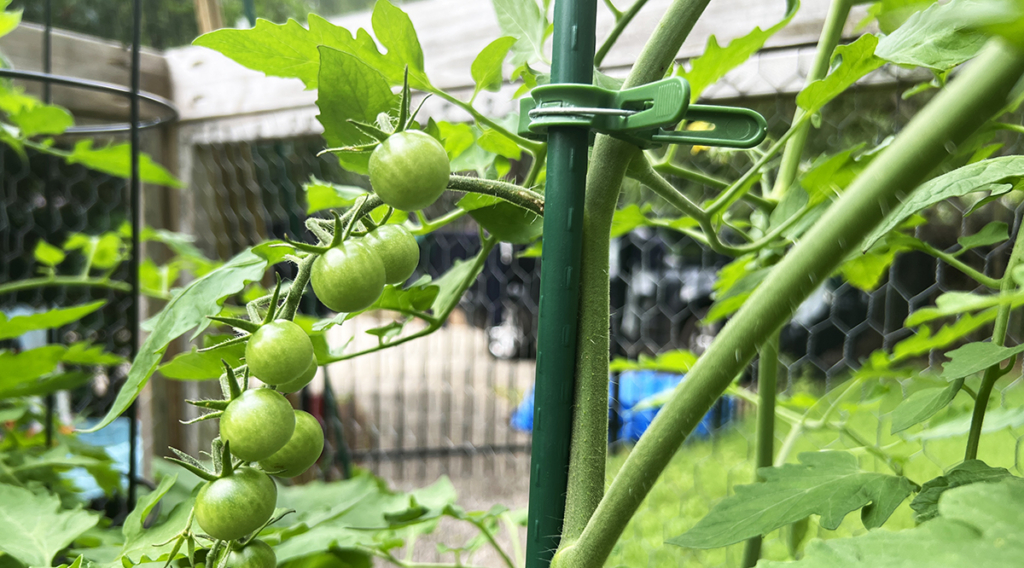

“At times, it can be a little challenging to keep tomatoes healthy, but no other vegetable comes close to bearing as much produce in such a limited space,” said Bob Westerfield, University of Georgia Cooperative Extension consumer horticulturalist in the College of Agricultural and Environmental Sciences. “Staking and pruning are two common practices that can help tomatoes stay healthier and produce larger fruit.”
First up: Determinate vs. indeterminate tomato varieties
While determinate tomato cultivars grow like a compact bush and produce a larger harvest all at once — perfect for those looking to can tomatoes or make sauces — tomato sandwich seekers are often better off selecting an indeterminate plant for a steady stream of tomatoes all season long.
These tomatoes grow on long, vining stems and produce fruit until the first frost as long as gardeners keep harvesting them.
Want to know more? Check out Westerfield’s “Georgia Homegrown Tomatoes.” This UGA Extension resource covers how to grow great tomatoes and avoid problems that gardeners often encounter.
Staking tomato plants
For the best chance at productive plants with healthy fruit, Westerfield urges home gardeners to invest in providing plants a strong support structure all season long.
“Because many diseases and insects start at the ground level, using a structured system to keep them away from ground contact is prudent,” Westerfield said. “Any system of tomato staking should provide a strong structure that will hold up to the elements and last the entire growing season.”
Want to know more? Check out Westerfield’s “Staking and Pruning Tomatoes in the Home Garden.” This UGA Extension resource provides an in-depth review of the staking and pruning methods covered in this story.
The single-stake system
The single-stake method is mainly used for determinate varieties; indeterminate or more vigorous types often need stronger support.
- Choose your stake: Use wood, plastic or metal. T-posts are the most durable.
- Place the stake: Insert 1 or 2 inches from the plant’s base, 6 to 12 inches deep depending on soil type.
- Wait until the plant is 10 to 12 inches tall to begin tying.
- Use soft ties: Garden twine, fabric strips or even pantyhose work well.
- Tie the plant every 8 inches up the main stem for support.
The double-stake system
Use the double-stake method for extra support compared to single-staking.
- Place two stakes on opposite sides of the tomato plant.
- Begin tying the plant to both stakes as it grows using soft ties.
- Maintain spacing between plants to allow for airflow and easy harvesting.
The cage system
Store-bought wire cones work for patio or determinate tomatoes in a cage system, but larger, vigorous plants may need sturdier cages.
- For strong cages, build your own using:
- Galvanized livestock fencing with 4-to-6-inch woven squares
- Concrete reinforcement wire with heavy-gauge mesh
- Wood (square, triangle or trellis design)
- Make cages at least 3 feet in diameter to allow room for plant growth.
- Ensure easy harvest access with large openings in the material.
- Secure the cage to the ground using small stakes or landscape staples, especially for top-heavy plants.
- Place the cage around your plant early, before significant growth, to avoid damaging the stems or fruit.
The Florida weave system
The Florida weave method gives tomato plants the support they need using only stakes and durable string. Use secure stakes — metal T-posts are preferred again for this method.
- Plant tomatoes in a straight row, spacing them appropriately.
- Insert stakes by inserting:
- One at the end of the row
- One for every third or fourth plant
- Tie a durable string to an end post, 1 or 2 inches above the ground.
- Weave string in and out between plants, looping around each middle post for added support.
- Tie off at the opposite end post to secure the row.
- Repeat the weaving process:
- Add new levels of string every few inches vertically
- Alternate sides of the plant with each new level
- Continue weaving as plants grow, keeping them upright between the woven strings.
Pruning tomato plants
To prevent the possibility of disease transmission, Westerfield suggests gardeners begin the pruning process as soon as plants are in the ground by removing all lower stems that come into contact with the soil.
- Use sharp, scissor-type hand clippers for clean cuts.
- Prune less for determinate varieties; indeterminate types benefit more from regular pruning.
- Remove sucker shoots to boost fruit production and airflow.
- Cut nonbearing branches selectively to allow more sun and air into the plant canopy.
- Remove damaged or diseased leaves/branches early to manage plant health.
- Clear all clippings from the ground to prevent disease spread.
- Disinfect clippers with an alcohol-based solution between plants to reduce virus transmission.
- Avoid over-pruning — tomato fruit needs some shade to prevent sunscald.
- Thin fruit as needed:
- Remove damaged or insect-ridden tomatoes.
- To grow larger fruit, trim clusters and leave only one tomato per group.
“Virtually every tomato variety can benefit from some type of support system as well as occasional pruning. By using these concepts, it is possible to extend the growing season from planting time in the spring until the first frost,” Westerfield said.
About the University of Georgia College of Agricultural and Environmental Sciences
The University of Georgia College of Agricultural and Environmental Sciences (CAES) is a conduit for leading-edge science education and research opportunities to reach students statewide. With campuses in Athens, Griffin and Tifton, all CAES students have the opportunity to work with nationally recognized and awarded faculty in plant pathology, horticulture, agricultural and applied economics, crop and soil sciences, and more. Learn more at caes.uga.edu.
About UGA Cooperative Extension
With groundbreaking, transformative research happening not only within the College of Agricultural and Environmental Sciences but across the University of Georgia, the ability to disseminate that information is of the greatest importance. For over 100 years, UGA Cooperative Extension has provided reliable, science-backed resources based on the latest scientific research to all of Georgia’s 159 counties. Learn more at extension.uga.
By Jordan Powers, University of Georgia
