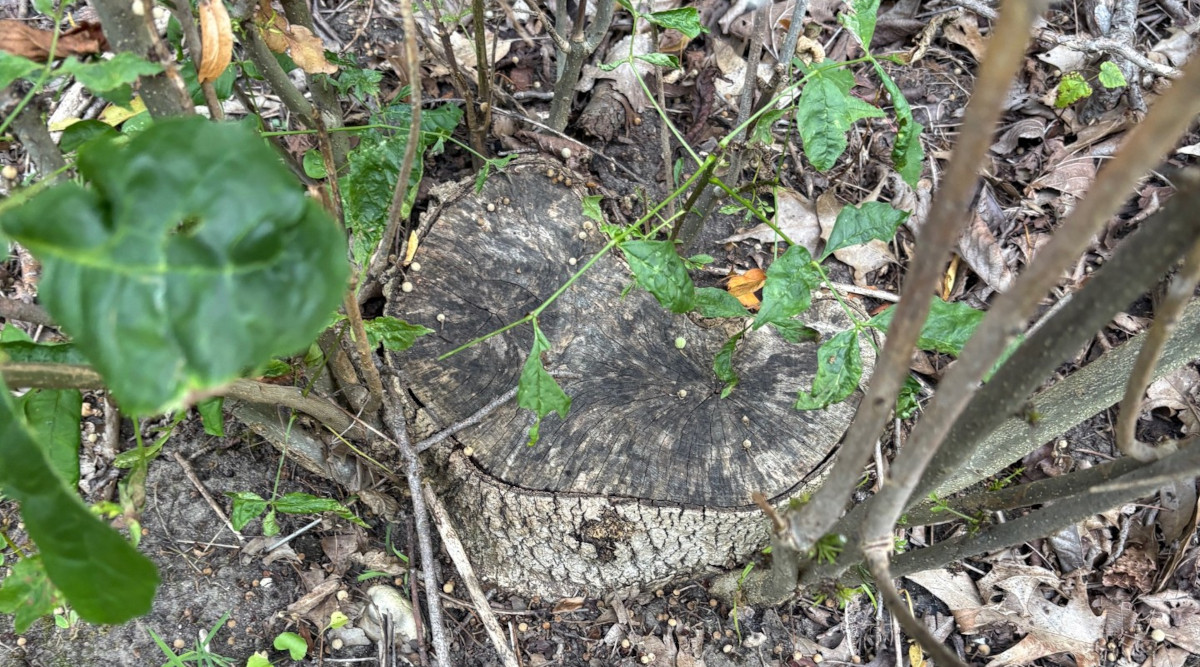

So, you have some junk trees in your fencerow or other locations, and you are wondering what to do. Simply cutting off such trees often results in the stump producing many sprouts and making more work for later.
Why do all these shoots spring up? The roots of these woody plants store a lot of energy. When the above ground portion of the tree is removed, the plant sends out fresh growth. Think of this as the plant’s survival instinct.
One way to reduce these sprouts is by treating the stump with a herbicide. You can apply the product directly to the cut surface of the stump soon after it’s been cut down, preferably within 10 minutes. The herbicide will be absorbed by the stump and help kill off the root system, stopping the new growth. Glyphosate, triclopyr, picloram, imazapyr and aminocyclopyrachlor are among the active ingredients (in the fine print on the label) used in the hundreds of brand name products labeled for stump treatments.
Some of these products are soil active, meaning if they run off a freshly cut stump and there is a valuable plant with roots running near the treated stump, you might injure the valuable plant. This can happen in windbreaks for instance. Read the label before you make the purchase. If the label uses language like “do not apply over the root system of valuable plants” this is your warning.
When applying a cut stump treatment, make your cut is as level to the ground as you can to prevent runoff. Mix and apply the product as written on the label. On small stumps, say 2 inches across or less, treat the whole cut surface. On large stumps, you need only treat the outer rings near the bark and green cambium layer. If you are cutting down a lot of trees in a small area, it might include an approved dye in the herbicide mixture to make it easier to know which stumps were already treated.
If the stump is in a public place, let the treatment do its thing for several months before you attempt to remove the stump for the soil. When you are sure no sprouts are coming you can remove the stump.
Let’s break down your options for getting rid of that tree stump. Be sure to call 811 if you are going to dig.
Grinding the Stump – If you want the stump gone fast, stump grinding the quick option. A professional can use a stump grinder to chew that stump up into little pieces in no time. The machine does the hard work, and the result is usually a bunch of wood chips left behind. While this is the easiest option, it is not the cheapest. Expect to pay for both labor and equipment usage, so if you are on budget, it might be worth considering other methods.
Digging It Out – A good option if you have time and some muscle to spare. Sure, it is labor-intensive, but it can be a satisfying and inexpensive option. The downside? It takes time, and not all stumps are created equal. Some have deep roots that might put up a real fight. Beware! Several people each year are injured or killed in Indiana when they try to pull stumps with tractors or other vehicles. It can also ruin transmissions.
Natural Decay – Most trees in fence rows or on the edge of a woods are left to slowly rot away. Just remember, the stump might take years to disappear fully. You might be able to accelerate the decay with the addition of a little nitrogen fertilizer placed on the stump every so often.
Using Fire – Some folks take a more dramatic approach and burn the stump out. A fresh cut stump often does not burn well. Just keep safety and conditions in mind.
Making the Stump a Feature – Larger stumps can be repurposed into a piece of yard art! You can carve it into a rustic table, plant flowers around it, or even create a small garden feature. It is not for everyone.
By Jeff Burbrink, Extension Educator, Purdue Extension LaGrange County
