
When I first started to study horticulture, I would routinely visit various public gardens to glean whatever knowledge possible about plants. Longwood Gardens was a frequent destination and I became intrigued by a short shrubby Maple growing adjacent to a sprawling clump of Bottlebrush Buckeye (Aesculus parviflora). To my surprise, it was not a Maple, nor was it even a woody plant! It was an herbaceous plant named Yellow Wax Bells or Kirengeshoma palmata (as seen below in June at Frelinghuysen Arboretum). Its bold texture and Maple-like foliage was very alluring and as usual, I wondered why I had yet to come across this plant in my journeys!

Kirengeshoma is a member of the Hydrangeaceae or Hydrangea Family and consists of two species. Kirengeshoma palmata is native to the large and more southern islands of Shikoku and Kyushu of Japan, where they grow in moist forested valleys at elevations of 2,000-6,000 feet. The genus and species were first penned and described in 1890 by the Japanese botanist Ryôkichi Yatabe (1851-1899). In 1876 Yatabe was the first citizen of Japan to graduate from Cornell University and upon returning to Japan he became the first Professor of Botany at the University of Tokyo. He crafted the genus name from the Japanese Ki for yellow and Rengeshōma or Renge Shoma in reference to Anemonopsis macrophylla, commonly known in the U.S. as False Anemone. A native of the main Japanese island of Honshu, False Anemone appears much like a pink, fall blooming daffodil and the pronounced central trumpet bears a strong resemblance to the overlapping flower petals of Yellow Wax Bells. Hence, the name Kirengeshoma describes a plant with a yellow flower that is similar in form to False Anemone. The species epithet of Palmata is Latin for ‘hand-shaped’ and describes how the foliage resembles a palm and fingers of a hand (as seen above). Maple trees also share this leaf shape, providing my excuse as to why I was fooled!
In fact, it is probably this bold Maple-like foliage that gardeners initially find most alluring about this shade loving plant. The oppositely arranged leaves can grow close to 8” in diameter and considering it usually reaches 3-4’ tall by an equal or slightly greater width, the plant clearly creates a large mass of wonderfully bold texture. In fact, some plants at Frelinghuysen Arboretum annually stretch to nearly 5’ tall and wide! Despite its size, the solid stems of the plant resist bending or breaking, eliminating any need for staking. Enhancing the bold leaf texture is the attractive dark purple petioles of the uppermost leaves that are mirrored by the purple color of the upper ⅓ of the stem (as seen below).

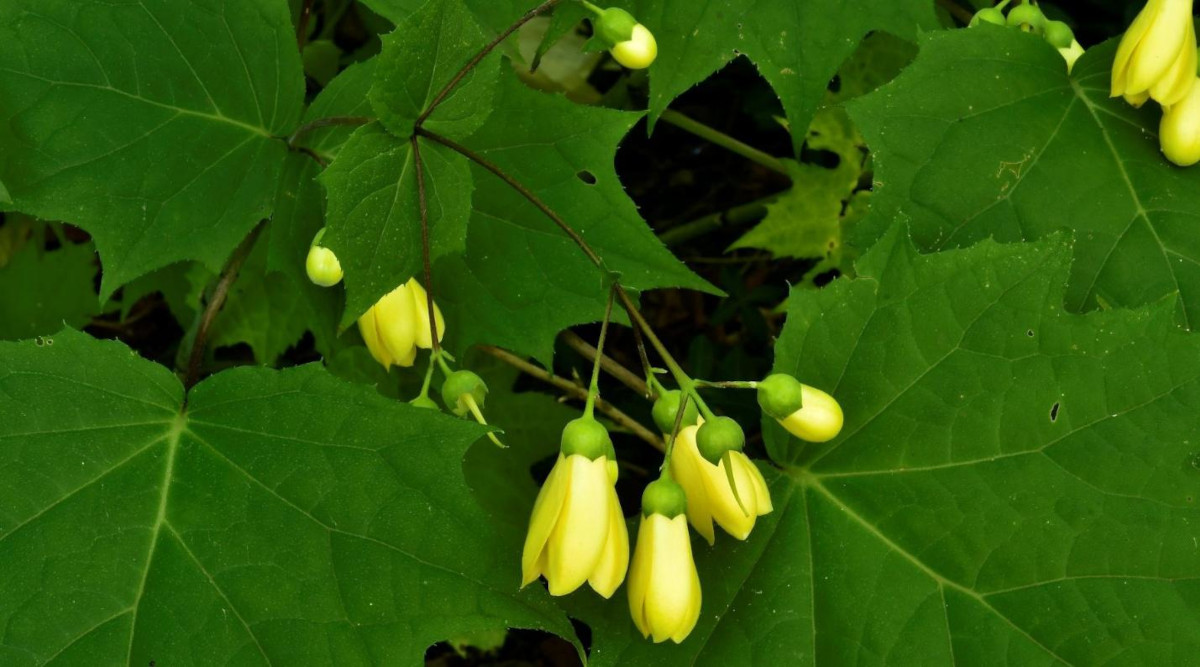
The flower buds begin to appear in early June at both the apical tips and from the leaf axils of the upper two or three tiers of foliage. For those flower buds growing from the leaf axils, they appear in clusters of 3 while those appearing at the tip of the stem often have two additional buds, appearing in clusters of 5. The flower buds are initially round and covered with small silvery hairs. As the buds start to open the yellow petals elongate and form a bell-shaped bloom (as seen in the top image in mid-September), inspiring the common name of Yellow Wax Bells.

The globe shaped flower buds may appear in early June, but they only serve to keep the gardener in constant suspense, considering the flowers do not begin to open until early August. Fortunately, the gardener’s patience is rewarded with an equally long floral display to follow, easily lasting throughout September. The flowers have a twisting and spiraling nature that is actually foretold by closely studying the buds where a nascent spiraling can be seen at the tips!

The curious flowers never fully open nor do they orient themselves for full viewing within. Rather, they are content to dangle downward, protecting the inner floral parts and appearing much like small golden lanterns. The spiraling arrangement of the flower petals can be seen at right with each petal overlapping its neighbor by roughly ½. The petals tightly encircle the 15 stamens and the 3 somewhat hidden styles within. The white stigma of a style can be seen above at the tip of the gray arrow.

Following pollination and shedding of the petals, the green cup-shaped calyx and the 3 lightly curved yet very prominent styles remain. The ovary and 3-chambered seed capsule are initially rather small following petal drop, but enlarge throughout October and by November have grown into a brownish-green sphere around ½” in diameter (pictured above in early November). The three prominent and now wavy, dark purple styles remain attached and give the seed capsule an appearance similar to some alien creature with a triad of legs or antennas. By late December the capsule splits open to reveal the three chambers and release the small tan seeds within. The seeds have small winged appendages, allowing the wind to help transport them to new sites. Despite the assistance of the wind and the numerous seeds produced, I have only seen a few seedlings near the mother plant and would never consider this plant to be invasive!
As mentioned, Kirengeshoma contains two species with the second species found in Korea. It was originally considered to be a variety of its Japanese cousin, but in 1935 the Japanese botanist Takenoshin Nakai (1882-1952) thought the plant to be sufficiently unique and named it Kirengeshoma koreana! At a casual glance, the two species appear virtually identical, yet there are a few unique differences. Probably the most obvious are the flowers! Instead of appearing like a dangling bell, the flowers are more outwardly oriented than dangling with the tips of the petals recurved or flared outwards, providing a more dramatic and trumpet-like appearance.

The flowers also appear a week or so earlier than its cousin. In addition, the plants lack the showy purple stems and petioles and are inclined to grow slightly taller and wider with somewhat smaller foliage. The differences are certainly nominal yet, combined with the more layered appearance provided by the slightly longer internode length (the length of stem between the leaves), the plant is distinctly unique!
Both species prefer acidic soils that are rich in humus and remain moist, yet not boggy throughout the growing season. Kirengeshoma is intolerant of neutral or alkaline soils and requires a pH below 6.5 to prosper. Typically, the plants prefer shade, although in locations where there is a consistent supply of moisture, the plants are certainly tolerant of more sun. The plants do well on the north side of a home or under the canopy of tall trees such as Tulip Poplar (Liriodendron tulipifera) or Oak (Quercus spp.). In those locations where plants receive a ½ day of sun combined with moist soils, the gardener is more likely be rewarded with a 5’ tall specimen, similar to those mentioned at Frelinghuysen Arboretum! The golden yellow flowers provide a wonderful air of beauty and elegance, especially if the plants are featured in a textural composition in a quiet part of the shade garden. Consider combining the plant with Maiden Hair Ferns (Adiantum pedatum), the Smooth Hydrangea (Hydrangea arborescens), Soloman Seal (Polygonatum spp.) or various shade loving sedges such as Rosy Sedge (Carex rosea). Where plants receive morning sun, consider underplanting Yellow Wax Bells with the relatively evergreen Black Mondo Grass (Ophiopogon planiscapus ‘Nigrescens’) as seen above in March. The dark purple foliage highlights the yellow flowers and repeats the purple petioles and stems! Both species of Wax Bell are hardy in zones 5-8, although Kirengeshoma koreana is reputed to be slightly hardier. In the southern reaches of its growing zone, a shaded site is certainly preferred.
For this novice gardener studying plants at Longwood Gardens, the tidy appearance of Kirengeshoma palmata combined with the bold Maple-like foliage provided all the qualities necessary to make me a lifelong fan. I never understood why they featured merely one plant with the Bottlebrush Buckeye, but I am very grateful to Longwood for providing me with the introduction to this herbaceous ‘Maple’ for the shade!
By Bruce Crawford, Manager of Horticulture, Morris County Park Commission
