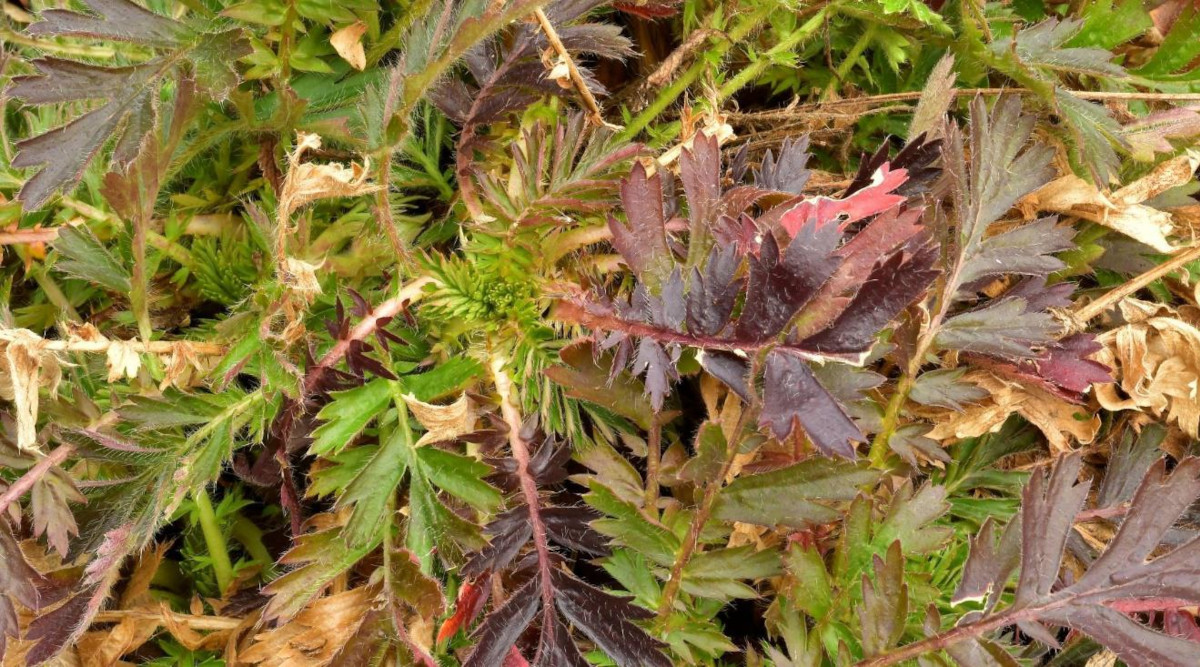

The garden often serves as a peaceful escape from the hectic world around us, especially during the hustle of the Holidays. Despite all the commercialization of the Holidays, it is still fun to have plants with seasonally appropriate colors and a touch of whimsey in the garden. In fact, with a bit of luck, that seasonal touch may extend well into the chill of winter to come. A plant rarely recognized for its colorful and seasonally appropriate foliage is Geum triflorum, commonly called Prairie Smoke. With colors of red, green, maroon and even orange (as seen in early December below on the right), the foliage certainly provides festive Holiday cheer!

Geum is a modest sized genus of around 50 species and is a member of the Rosaceae or Rose Family. Although modest in size, its global reach is vast with species found in North and South America, Europe, Asia, Africa and even New Zealand! Geum triflorum is native from Ontario and New York west to British Columbia and south to New Mexico. The genus name was crafted and published in 1753 by the Swedish botanist Carl Linnaeus (1707-1778). The root of the name possibly comes from either the Greek Geno, meaning “to give off an agreeable fragrance” or Geuo meaning “to taste”, both in reference to the clove-like fragrance from the roots of certain species.
Prairie Smoke was described in 1813/14 by the German American botanist Frederick Traugott Pursh (1774-1820). Educated at the Dresden Botanic Gardens, Pursh emigrated to the US in 1799 and worked primarily in the Philadelphia area, although he spent two years traveling and studying plants from the Carolinas to New Hampshire. Pursh named and published this species in his two-volume work Flora Americae Septentrionalis (A Systematic Arrangement and Description of The Plants of North America), with the first volume published in 1813 and the second in1814. Many of the plants described were from his travels throughout North America. However, the specimen of Geum triflorum he studied was collected by the English botanist John Bradbury (1768-1823) during his 1811 expedition along the Missouri River. Pursh somehow gained access to the Bradbury’s plant collection, both describing and publishing this plant in his two-volume treatise without Bradbury’s permission. The species epithet of triflorum or three-flowered refers to the arrangement of the flowers in groups of three.

The dense foliage of Prairie Smoke appears in whirls of closely arranged rosettes (as seen on the left in early October). The rosettes grow from short basal stems, botanically known as caudices (singular is caudex) that emerge from compact, slowly expanding rhizomes. Each 6-8” long leaf loosely resembles a fern frond with its central stem sporting upwards of 19 leaflets arranged oppositely along the stem. The foliage can reach heights of 18”, although 10-12” is more the norm. From April through October the foliage is a deep forest green with numerous hairs appearing along the margins and lesser amounts on the leaf surfaces. The hairs serve to capture water from heavy dews and disrupt the persistent winds of the prairies, thereby reducing water loss. During exceptionally dry summers the foliage can go dormant, but this is more typical to Western prairies than in garden settings. In gardens, the foliage may collapse to the ground during an extended drought or when temperatures become extremely cold, but otherwise it stands proud! Starting with the first frosts of mid-October, the foliage gradually changes into its winter wardrobe of glowing red, orange, deep purple and bright green colors. The closing image shows the colors in early January. The silvery white hairs of the foliage show off quite nicely against the deep purple leaves, a trait the keenly observant gardener may enjoy!

Starting in March, the highly pubescent red flower stems begin to expand. The image above was taken on March 7th at Willowwood Arboretum in north central NJ. At the tip of each stem appear two highly dissected bracts or modified leaves that intertwine together, much like the fingers of two clasped hands. Their mission is to protect the flower buds within. While still close to the ground, these bracts begin to open, typically exposing 3 flower buds, with all three of the floral stems or pedicels originating from the same point of the main stem. It is this trio of flowers that inspired the species epithet. However, the floral count is not always ironclad since there may be but merely one bud or on the rare occasion, upwards of nine! The pubescent buds are urn shaped and initially hang downward with the narrow end of the flower oriented towards the ground, as seen above and below. This orientation protects the flower from rains and even late season snowfalls. The flower buds measure ¾-1” in diameter and in length. The 5 pink bracts or sepals of the calyx remain tight around the bud, concealing all but the very tips of the light yellow to pink petals within. In addition, there are 5 narrow bracts called bracteoles that flair outward from the base of the bud. Each of these linear bracts originates from a point in-between the 5 sepals of the calyx and are of the same color (as readily seen below).


The flowers are pollinated by Sweat Bees (Lasioglossum species) who squeeze into the narrow opening in search of nectar. The are also pollinated be Bumble Bees who often ‘buzz pollinate’ the flower. This involves the bee grasping the flower and hanging upside down beneath the narrow opening. They then proceed to beat their wings, shaking pollen and nectar free that subsequently lands on their abdomen. During these processes, the plants are either self-pollinated or pollen is transferred via the bee from a previously visited flower. Of course, there is always an insect looking for a free meal and many wasps, beetles and even bees will cut a hole at the base of the flower to steal the nectar within without aiding in pollination!
Following pollination is when the flowers really get smoking! No longer needing protection from the weather, the floral stems or pedicels straighten, drawing the flowers into an upright position. The calyx finally opens fully, allowing the light-yellow petals to be seen as they too reflex outward (as seen below). The numerous styles or stems that connect the stigma with the ovary lengthen to nearly 3” in length and dramatically project upwards from the flower. Initially, the styles are in a twisted cone shape before separating into individual filaments and becoming more upright (as seen below). Adding to the drama, the styles are light pink in color and are covered in hairs, giving the appearance of smoke and providing the inspiration for the common name! The smoky styles remain impactful well into late May and June (as pictured at right and below in late May). Similar to the parachute-like pappus of Dandelions and coma of Milkweeds, their function is to allow the wind to transport the achene or one seeded fruit to a new location. Certainly, a wonderful touch of beauty and whimsy for the spring garden! Prairie Smoke will self-sow lightly, but without those strong prairie winds, the seedlings do not venture far from the mother plants.


Prairie Smoke is found in a diversity of locations in the wild, varying from well-drained sandy and gravely soils to more moisture retentive loamy soils and even along stream banks! The key is for the soil to be well-drained and in full sun, although plants are also native to open woodlands. Plants are hardy in zones 3-7 and ideally the soil should have a pH between 6.5-7.2. As a prairie plant, it grows well with midsized plants accustomed to similar cultural conditions, including Black-eyed Susan (Rudbeckia spp.), Prairie Dropseed (Sporobolus heterolepis), Little Bluestem (Schizachyrium scoparium), Prickly Pear (Opuntia spp.), Blazing Star (Liatris aspera) and Bowman’s Root (Porteranthus trifoliata).

December is certainly not a month known for attractive herbaceous plants and especially not for their foliage! The flowers, followed by the smoke-like drama of the styles would seem to be a sufficient reason to grow the plant, but when combined with the gorgeous foliage of winter, it is hard to understand why this plant remains so little known by gardeners. Without question, this is a plant that should appear on more wish lists, since this is a ‘smoking’ good plant for the Holidays! Happy Holidays to all and to all, a great gardening year to come!
By Bruce Crawford, Manager of Horticulture, Morris County Parks Commission
