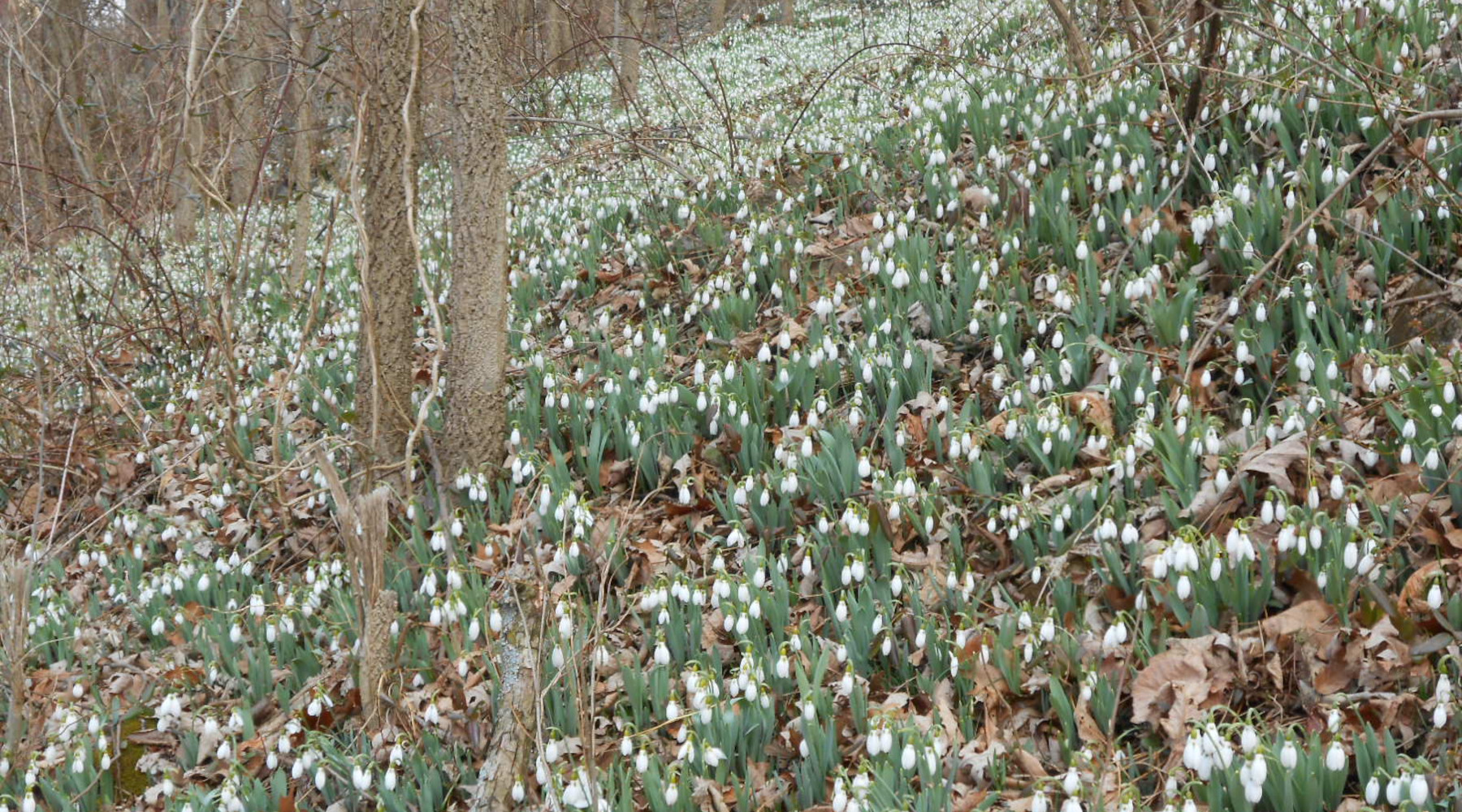

To remind us that spring will return, snowdrops poke their heads out of the ground, sometimes as early as Groundhog Day. But they are prettier than groundhogs, smell nicer, and are better behaved in the garden.
As the recent snowpack begins to retreat with warming temperatures and increasing sunshine, the snowdrops are starting to appear in my garden. In milder winters, snowdrops will begin flowering as early as January, but not this year. The diminutive blooms last for several weeks and seem unfazed by cold, snow, and ice.
Another common name for snowdrops is February Fair Maid; the scientific genus name, Galanthus, means “milk flower” in Greek, so named for the milky-white color of the flowers. Somewhat surprising, considering their cold tolerance, most snowdrop species are native to the Mediterranean region, including Iran, Turkey, and the Balkans.
The flowers are fragrant, but we usually don’t notice because they bloom when it is cold outside. Once the flower warms up, it carries a slight but sweet fragrance. Although small, snowdrops last a long time as cut flowers.
There are people whom other gardeners call “galanthophiles.” These are snowdrop fanatics who obsessively collect every variety of snowdrop to be found and who spend cold winter days examining the tiny details of the flowers. Within the several species, there are hundreds of distinct forms, with variations in the size of the foliage, the height and angle of the flower, the shape of the outer petals, and the greenish stripes and splotches that appear on the inner petals, which have been selected and named. Many of these are hard to find and command a hefty price, upwards of $100 for a single bulb.
Because of the huge demand for snowdrop bulbs generated by such collectors, all Galanthus species are now listed in CITES (the Convention on International Trade in Endangered Species of Wild Fauna and Flora), which in theory monitors and controls international trade in threatened species. All snowdrop bulbs sold must be nursery propagated rather than collected in the wild.
By no means a galanthophile, I am just happy to see flowers in my garden even when there is still snow on the ground. It’s an assurance that soon there will be other small flowering bulbs unfurling their petals to the warming sun, a welcome sight to emerging bees and gardeners alike.
Following soon after the snowdrops are snow crocuses, selections of several different Crocus species, most commonly C. chrysanthus and C. tommasinianus (commonly called “tommies”). These also are native to Turkey and the Balkans, and, as with snowdrops, do best in well-drained soil. They are partial to full sun, warm weather during spring, and dry conditions during their summer dormancy.
Flowering in very early spring, of a smaller stature than the more common “Dutch” crocus, and lightly fragrant, snow crocuses offer a wide range of color blends, from white, cream, lilac, and rosy purple to yellow, orange, and bronze, often with veining, feathering, or stripes on the outer petals (more correctly, tepals). Varieties include ‘Blue Pearl’, ‘Cream Beauty’, ‘E.A. Bowles’, and ‘Ruby Giant’.

Another very early spring bloomer is winter aconite (Eranthis hyemalis), with cheerful daisy-like blooms of bright yellow surrounded by a fringe of green. Flowers appear before the foliage, opening close to the ground; the stems get longer as the seed ripens and the leaves appear. You will often find them growing under deciduous trees and shrubs, and in older gardens, they will seed in to form large drifts over the years.
All of these are low-growers, blooming at less than six inches above the ground, but they stand out even at a distance amidst the general tan drab of soil, dormant grass, and mulch. Because they all grow from small bulbs that are so easy to plant in fall, and because they will naturalize and spread, it’s easy to have hundreds of them to help you usher in spring.
By Annette MaCoy, Master Gardener Coordinator, Penn State Extension – Franklin County
