
Dandelions are the most identifiable weed in Indiana lawns. Some people get pretty excited this time of the year when the little yellow flowers open up.
Dandelion is a perennial broadleaf weed that is a member of the daisy family. It prefers full sun and grows best in moist soils. However, it can survive in multiple environmental conditions and management practices including shade, low mowing, drought and low soil fertility.
The flowers generally appear in early spring as they regrow from a few overwintering leaves and their taproot, but you can find them blooming even in October. The majority of dandelions flower from late April to mid-May in Indiana. Their yellow flowers consisting of sunflower-like petals, are produced at the ends of long, leafless, erect stalks. Dandelions typically flower in their second year of growth after germinating from seed.
The yellow flowers very quickly convert into a conspicuous, globe-like, white seedhead with light, feathery ends capable of easy dispersal by the wind. Each seedhead is capable of producing 140 to 200 individual viable seed, which can drift through the air for miles. Dandelion seeds germinate from late spring (after flowering and seed dispersal) to early autumn.
Leaves have distinct wavy margins that form into the irregular ‘toothed’ appearance that makes the plant easily identifiable. The ends of the ‘teeth’ tend to point downward towards the base of the plant.
Dandelions have a very strong, sturdy taproot. The plant has the ability to regenerate from surviving taproot segments, so hoeing a dandelion from your garden or lawn may not actually kill the plant. The survivability of this taproot helps to make dandelion a very difficult to completely control weed in lawns in Indiana, even following herbicide applications.
There are no super effective natural controls out there for dandelion control. However, growing a healthy stand of grass can help to minimize the influence of the weeds. Fertilizing three times a year, mowing at least 3 inches in height, and watering deeply and infrequently (not every day) can thicken the grass and crowd out some of the weeds.
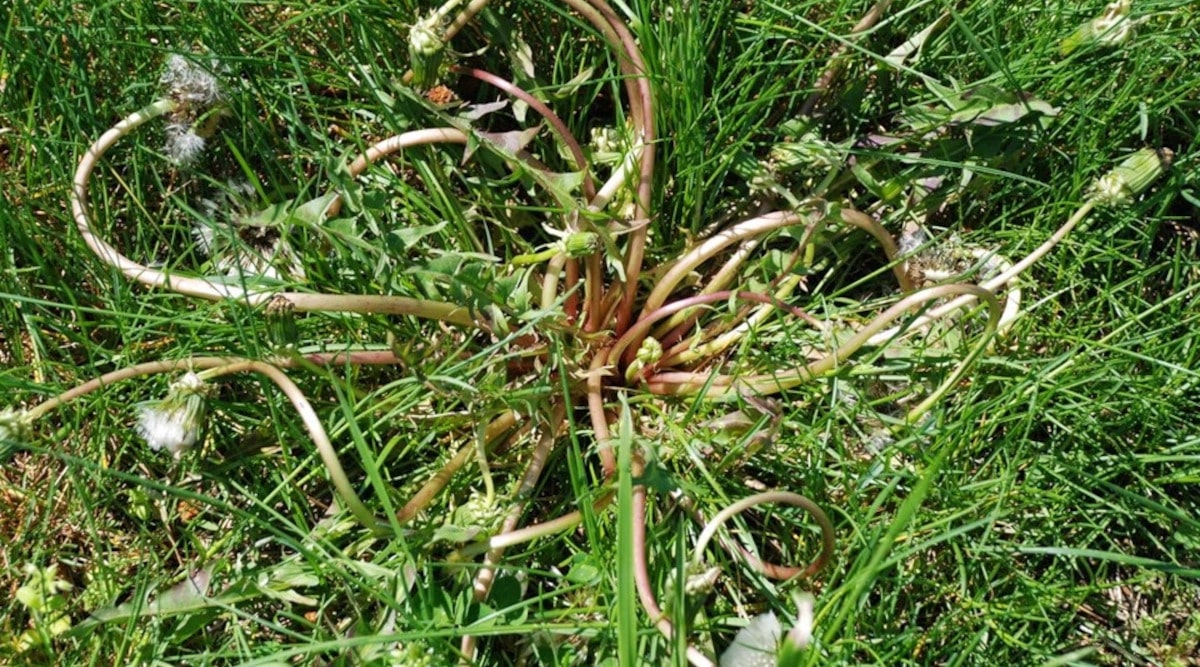
There are dozens of herbicides that effectively control dandelions, particularly those that contain 2,4-D. But spraying them in April and May often leaves people disappointed. The plants curl up, giving people hope, then they go ahead and produce seed. Springtime applications tend to fry the top of the plant off, and do not kill the root.
The best time of the year to get the dandelion under control in northern Indiana is in the fall. A dose of a three-way broadleaf herbicide for lawns containing 2,4-D, dicamba and mecoprop in late September or early October can change the way your dandelion patch looks next spring. Why does this work so well? The herbicide gets absorbed by the plant as it prepares to bed down for the winter, causing the roots die off. Wait at least 24 hours after spraying before you mow to give the product time to get absorbed into the plant.
Please remember, if you chose to spray your turf for dandelions and other broadleaf plants, be sure to return the treated clippings to the lawn, and do not use them as mulch in the garden. The clippings will contain enough of the herbicide to curl up your tomatoes and other sensitive plants in your garden for up to 10 weeks.
For more information on lawn care, visit https://turf.purdue.edu/homeowner-publications/
By Jeff Burbrink, Purdue Extension LaGrange County
