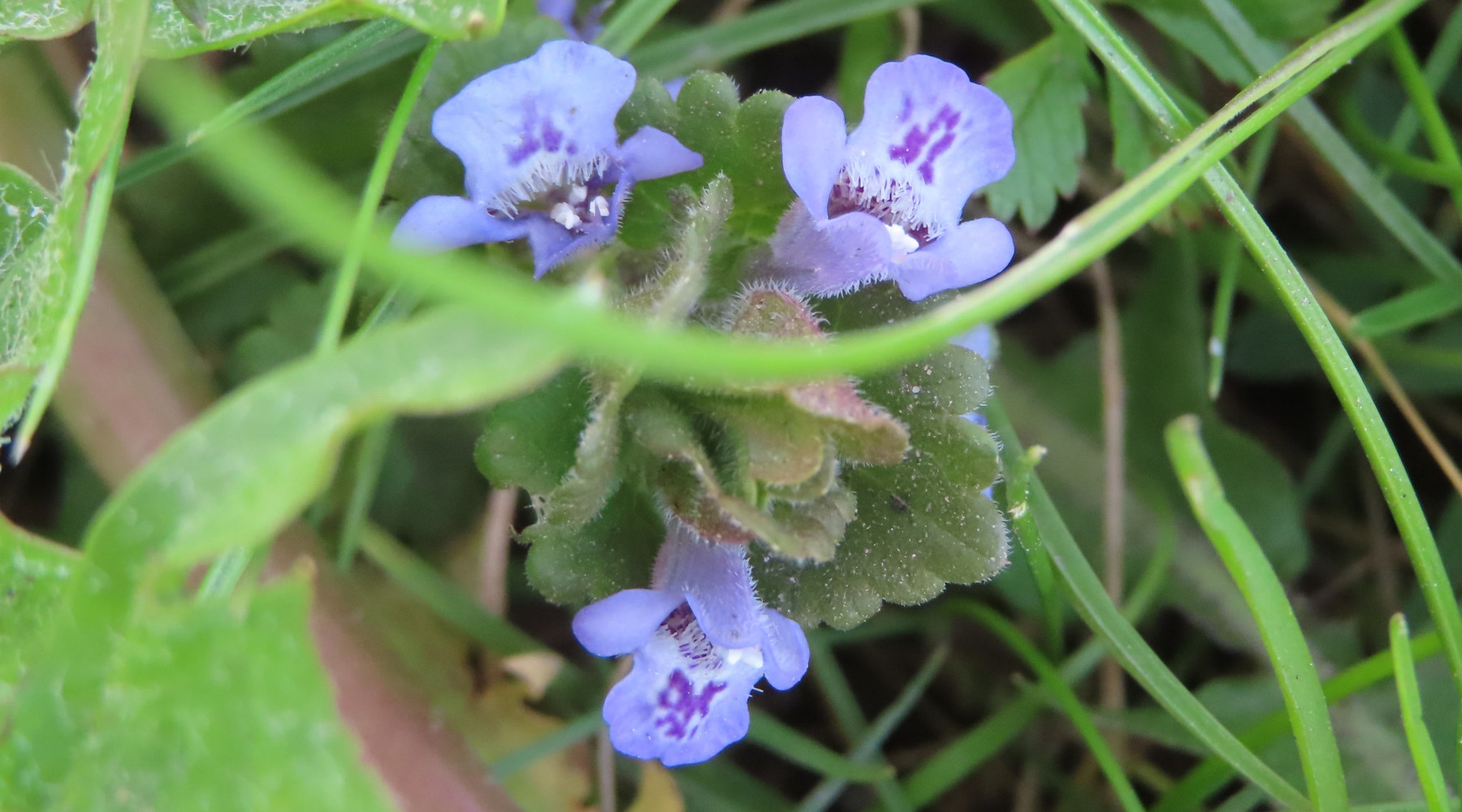

As we go through our landscapes in spring and begin the inevitable task of weeding, there is one plant we commonly encounter. It creeps through shaded lawns, slips beneath shrubs, and roots wherever it touches the soil. With its small purple flowers, creeping Charlie (Glechoma hederacea) may seem harmless at first, but over time it can spread aggressively and crowd out desirable plants, making it one of the most common and frustrating weeds in our landscapes.
Where did it come from?
Creeping Charlie, also known as ground ivy or gill‑over‑the‑ground, is native to Europe and Asia and was introduced into North America by early colonists, likely for medicinal and ornamental purposes. It was first found in Illinois in 1846. Since then, it has spread throughout the United States and Canada.
What does it look like?
Creeping Charlie has green, round to kidney-shaped leaves with rounded, toothed margins. The leaves are arranged opposite each other along the stem. Like other plants in the mint family, they have square (four-sided) stems. The plants will creep along the ground and can root at the nodes (where the leaves emerge from the stem) and can reach 2.5 feet in length. Plants will produce small, funnel-shaped purplish-blue flowers from April to June. When crushed, the leaves have a minty smell.

Managing creeping Charlie
Creeping Charlie can grow in a wide range of conditions, but prefers shaded areas with damp, fertile soils. This is why it is often an issue in shady areas of lawns, where it can form large patches and move into sunnier areas. Turfgrass growing in shade will have a difficult time out-competing creeping Charlie. Try to maintain healthy, dense turf by using shade-tolerant grasses such as fine fescue, mowing higher (around 3 inches), fertilizing as needed, and overseeding in the fall.
Another, and perhaps better, alternative is to mulch under trees and/or grow shade-loving ground covers such as sedges and wild ginger, or other shade-loving plants like hostas and ferns, which will be better able to compete with weeds.
If an area is not heavily infested with creeping Charlie, it can be removed by hand. This is a good option for plants in planting beds. Make sure to pull up all the roots and stems and remove them from the area, or the plants will grow back or re-root.
Creeping Charlie can also be managed with herbicides when plants are actively growing in mid-spring to early summer and/or mid to late fall. Look for products containing 2,4-D, mecoprop (MCPP), dicamba, or triclopyr. Make sure to read and follow ALL label directions. You may need to make multiple applications to get adequate control. If you have a severe infestation, it may be easier to start over by using a non-selective herbicide, such as glyphosate, and reseed the lawn (this should be done in the fall).
These products should only be used in lawns, not in vegetable gardens or flower beds, because many of these plants are easily damaged by these herbicides. It is best to hand-pull creeping Charlie in these areas.
Good Growing fact of the week: Before hops were used to brew beer, creeping Charlie was often used to flavor, as a preservative, and as a clearing agent in beer. This is how it got the name gill‑over‑the‑ground. Gill is from the French word guiller, meaning “to ferment ale”.
By Ken Johnson, Horticulture Educator, University of Illinois Extension
