
Native plants are beautiful, and they are the backbone of healthy landscapes. Because they are adapted to our local soils and climate, once established in the landscape, they can thrive on less attention from the home gardener. Native trees and shrubs provide a living habitat that supports wildlife by feeding birds, sheltering pollinators, supporting caterpillars, and making your yard part of the larger ecosystem.
Many Penn State Extension Master Gardener volunteer programs across the state hold Plant Sales during the months of April and May. Plant Sales are a way to raise funds for the educational outreach that Master Gardener volunteers provide in their local communities. For customers, Plant Sales are not only a place to find a great selection of plants but also to talk one-on-one with knowledgeable and informative Master Gardener volunteers about all aspects of home gardening.
This year, the Penn State Master Gardeners of Franklin County’s Plant Sale on May 16 will feature a selection of native trees and shrubs, at very reasonable prices and in small containers for easy planting. Some shrubs, such as inkberry, witch hazel, summersweet, sweetspire, and steeplebush spirea, don’t tower over yards but easily blend into landscapes while trees, such as maples, white oak, and black gum, will slowly reach for the sky. These native trees and shrubs will help to bring a backyard to life.
Sugar Maple (Acer saccharum)
Sugar maple is the classic autumn showstopper, the one you see in photos of autumn in New England, turning entire hillsides gold and orange. Birds and small mammals rely on its seeds and buds. It thrives in full sun with well drained soils, growing slowly into a stately, long lived shade tree with an upright oval to rounded crown, attaining 60 to 75 feet in height in the landscape.

Red Maple (Acer rubrum)
Red maple lights up the neighborhood in fall with yellow to brilliant scarlet foliage that stops people in their tracks, but its early spring red flowers that feed hungry pollinators also stand out in a still leafless landscape. Red maple grows well in full sun and moist to average soils, provides reliable shade and year round beauty, and reaches 40 to 60 feet in the landscape.
Summersweet (Clethra alnifolia)
Summersweet, also called sweet pepperbush, sends out fragrant, bottlebrush blooms in midsummer, just when the garden needs a lift, contrasted against lustrous, deep green leaves that turn yellow in fall. Bees and butterflies flock to its nectar. Summersweet thrives in sun or part shade with moist soils, making it perfect for rain gardens and damp corners, forming a dense, rounded shrub that slowly grows 3 to 4 feet high and up to 8 to 10 feet wide.
Common Witch Hazel (Hamamelis virginiana)
Witch hazel unfurls its ribbon like yellow flowers in late autumn. It is the only Pennsylvania native plant that blooms so late in the season, offering a “last snack” nectar and pollen source for late-ranging insects. Witch hazel can grow from 15 to 30 feet in height, forming a rounded crown of arching stems. It is a highly adaptable and long-lived plant that thrives in part shade to full sun and moist to dry soils, adding a spark of yellow flower and leaf color to the year’s final days.
Inkberry ‘Shamrock’ (Ilex glabra)
‘Shamrock’ inkberry forms a neat mound of shiny dark green foliage that stays lush and green through winter, slowly growing to 3 to 5 feet in height. The greenish-white flowers that appear in spring attract pollinators, including honeybees. It thrives in sun or part shade with moist, acidic soils and offers an excellent native alternative to boxwood.
Sweetspire ‘Henry’s Garnet’ (Itea virginica)
Sweetspire drapes itself in subtly fragrant white flower spikes in early summer, followed by long-lasting deep red and burgundy foliage in fall. Pollinators are drawn to the blooms, and songbirds eat the seeds, held in pods that persist through winter. ‘Henry’s Garnet’ sweetspire thrives in sun or part shade and moist, acidic soils, spreading gently to form graceful colonies, about 4 feet high by 6 feet wide.
Black Gum (Nyssa sylvatica)
Black gum, also called sour gum and black tupelo, colors early in fall in spectacular shades of scarlet, coral, and orange. The bright leaf color is a signal that its dark purplish berries are ripe and ready to fuel migrating birds on their way to winter habitats. Black gum grows in sun or part shade, tolerating both moist lowlands and drier upland soils, slowly reaching heights of 30 to 50 feet in the landscape.
Northern White Oak (Quercus alba)
White oak is a majestic, centuries long presence with a wide, welcoming crown and soft, pale bark. It supports more caterpillar species than almost any other tree – an essential food source for baby birds – and its acorns provide sustenance to many birds and mammals. White oak thrives in full sun with well drained soils, slowly attaining heights of 50 to 80 feet in the landscape. Its beautiful bluish-green leaves with rounded lobes often turn deep red to maroon in fall and may hang on the tree until the following spring.
Steeplebush Spirea (Spiraea tomentosa)
Steeplebush sends up rosy-pink flower spikes that look like small summer fireworks in the meadow, on stems reaching 2 to 4 feet in height. Its nectar attracts bees and butterflies, and it thrives in full sun with moist to wet soils, adding color to rain gardens, wet borders, and wetland meadows.
Red Chokeberry (Aronia arbutifolia)
Red chokeberry saves its fireworks for fall, with blazing scarlet leaves and red berries that last into winter, a great alternative to invasive burning bush. Birds rely on the berries when food is scarce in late winter. It grows well in sun or part shade, in moist to average soils, forming spreading colonies of upright stems 6 to 10 feet in height.

False Indigo Bush (Amorpha fruticosa)
False indigo bush brightens early summer with intense purple flower spikes tipped in gold. Bees come for its nectar, and it is a larval host for several butterflies. With slender stems ranging from 4 to 15 feet tall and bright green foliage, indigo bush thrives in full sun and is adaptable to soils ranging from moist to very dry and poor, enriching the soil around it as a nitrogen fixer.
Sweetbay Magnolia (Magnolia virginiana)
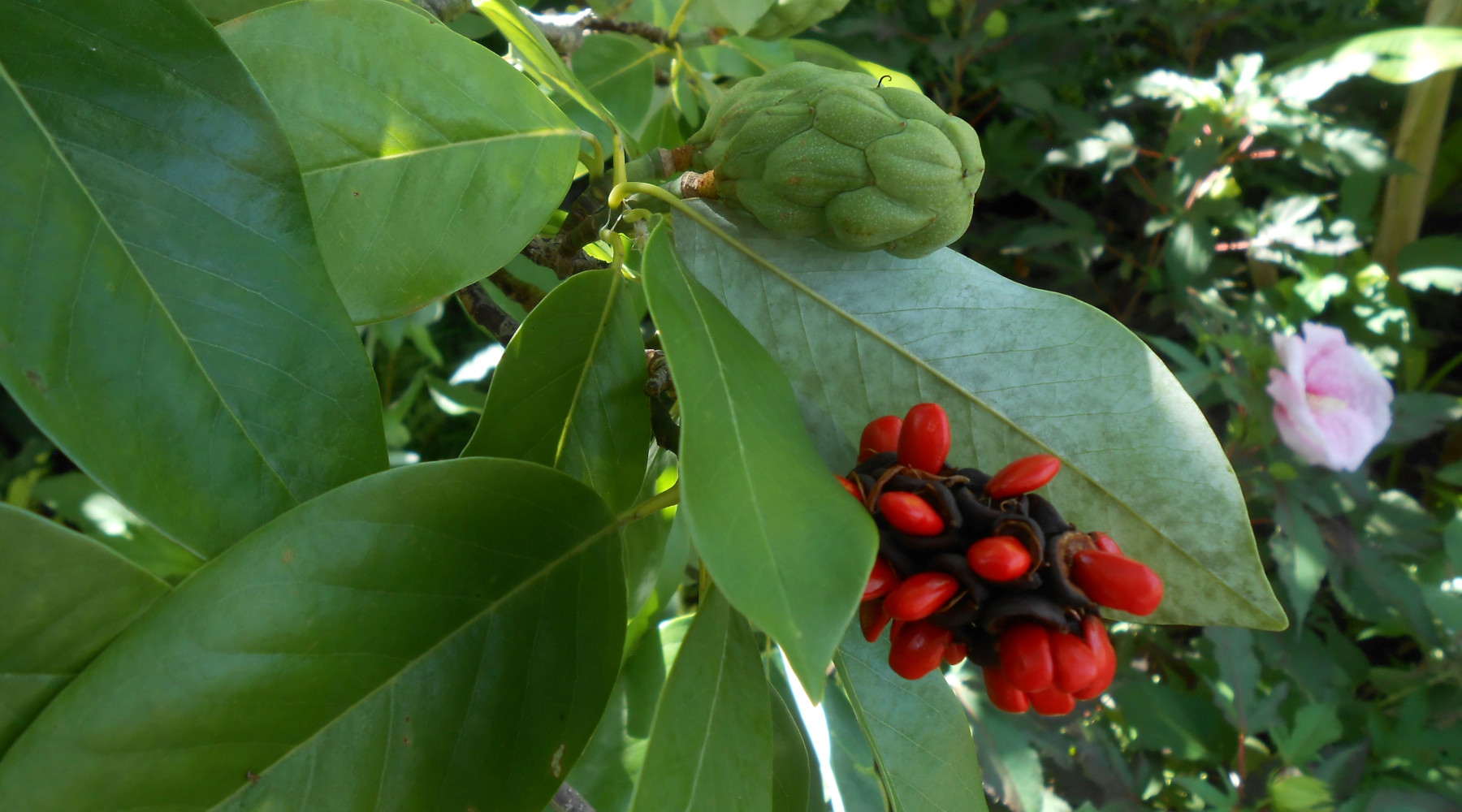
Sweetbay magnolia’s blossoms pop against shiny dark green leaves and have a lemon-vanilla scent. Pollinators visit the fragrant flowers, and it hosts many butterfly larvae. The dense foliage, dark green above and silvery beneath, often remains into winter, providing shelter for birds. The multiple stems of this small tree reach 10 to 20 feet in height in colder climates, and it thrives in sun or part shade with moist to wet soils.

These twelve native trees and shrubs – from the red fall glow of black gum to the summer fragrance of summersweet, from the winter berries of red chokeberry to the sheltering leaves of sweetbay magnolia – offer beauty with purpose. Each one supports the insects, birds, and wildlife that keeps our yards alive. The ease of care for these natives gives us time to enjoy nature as we move through the seasons. Adding just one native plant is a small act of restoration.
By Carol Kagan, Penn State Master Gardener, Franklin County
