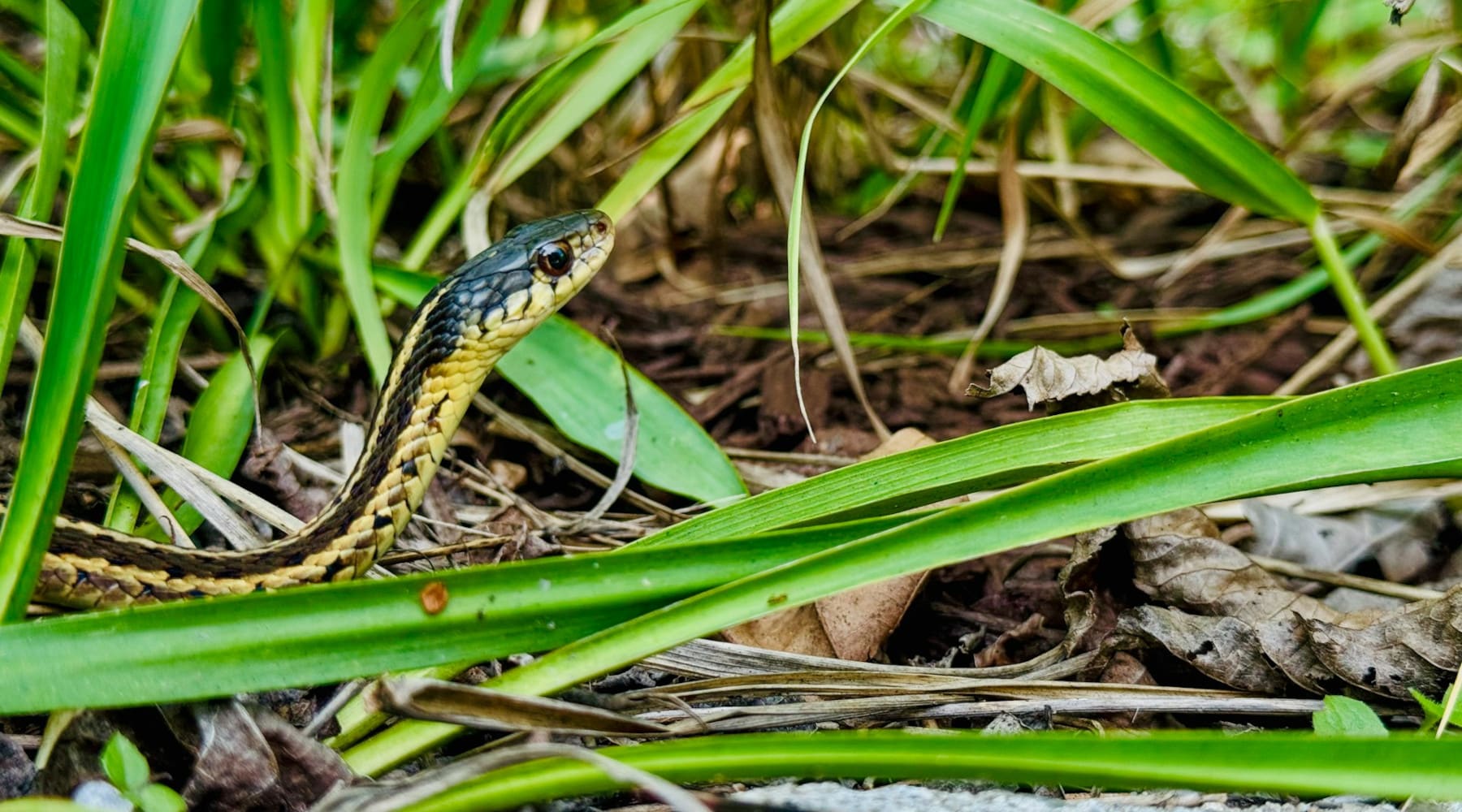

Ophiophobia – the fear of snakes. I am frightened of snakes. Seeing a snake stops me in my tracks, leaves my heart pounding, and leaves me barely breathing as my eyes are fixed on the reptile at hand. As someone who has made a living working outside much of my life, I encounter snakes regularly in my day-to-day activities, but I still prefer to avoid them. Often during the first half of summer, I get my fill of snakes.
Not long ago, I found myself relocating a five-foot black snake, only to have it return an hour later. A sharp stream of water from the hose persuaded it to stop climbing up to our hummingbird feeder. At the same time I was hooking up the hose, I came face-to-face with a garter snake in our window well, with a toad halfway in its mouth.
I berated the garter snake for eating a beneficial toad, but he was too busy using the side of the window well to shove the toad into his mouth to notice my insults. I left him to his meal.
Despite my own ophiophobia, snakes are incredibly beneficial and misunderstood.
The typical diet for our Midwestern snakes is insects, mollusks (i.e., snails and slugs), worms, and rodents. Snakes do not damage plants, and they cannot chew or make holes; instead, they take advantage of existing openings in structures.
Snakes generally avoid people and bite only if threatened or handled. If you are bitten by a non-venomous snake, it feels akin to being slapped on the hand or getting a minor scratch. Many smaller non-venomous snakes don’t have teeth long enough to puncture skin, and those that do cause minor scratches or punctures.
Venomous snakes are rare in Illinois, and their presence varies by location in the state. In total, we have four species of venomous snakes: Copperhead, Cottonmouth, Massasauga, and Timber Rattlesnake. All of these venomous snakes have broad, triangular-shaped heads; however, so do some non-venomous snakes. Some snakes will flatten their heads when threatened, which makes them look like venomous snakes, even if they aren’t. If you can’t confidently identify the snake, leave it alone. Head shape alone is not a reliable way to identify venomous snakes.
The reason snakes are present is that the habitat is conducive to their needs. The following are tips to modify the habitat to discourage the presence of snakes:
- Replace loose rock walls. Snakes like to crawl in or behind stone that helps keep their cold-blooded bodies warm. Replace loose stone walls with a tight-fitting concrete block or timbers.
- Keep plant material short. Long grassy weeds provide good cover for many animals, including snakes. Staying on top of mowing will leave snakes more open to predation, which they will tend to avoid.
- Remove or relocate other debris such as piles of rocks, bricks, brush, or wood.
- Repellents such as mothballs or sprays do not work. The only item shown to occasionally deter snakes from basking is sharp lava rock. Place lava rock adjacent to structures to prevent snakes from basking near that building. According to University of Nebraska Extension, install lava rock beds 2 to 3 feet wide and 5 to 6 inches deep.
- Fencing or screening with holes less than ¼-inch will keep snakes out.
- Caulk and seal openings greater than ¼-inch in the foundation and siding. Remember, snakes cannot chew; any caulking will work.
- Caulk or seal joints and seams around outdoor steps or patios.
- Remove birdseed feeders during the spring and summer. Birds can easily find their own food during spring and summer. Birdseed attracts rodent pests, which in turn draw in snakes.
Hopefully, my snake experiences are over for the year, but I know this is not the case. In the end, my ophiophobia may drive me north of the Arctic Circle.
Good Growing Fact of the Week: Snakes can carry diseases like Salmonella; however, the risk of diseases is no greater than that of a dog or cat. Snakes do help control rodents, which can harbor significant zoonotic diseases. Always wash your hands after handling snakes or petting the dog.
By Chris Enroth, Horticulture Educator, University of Illinois Extension
