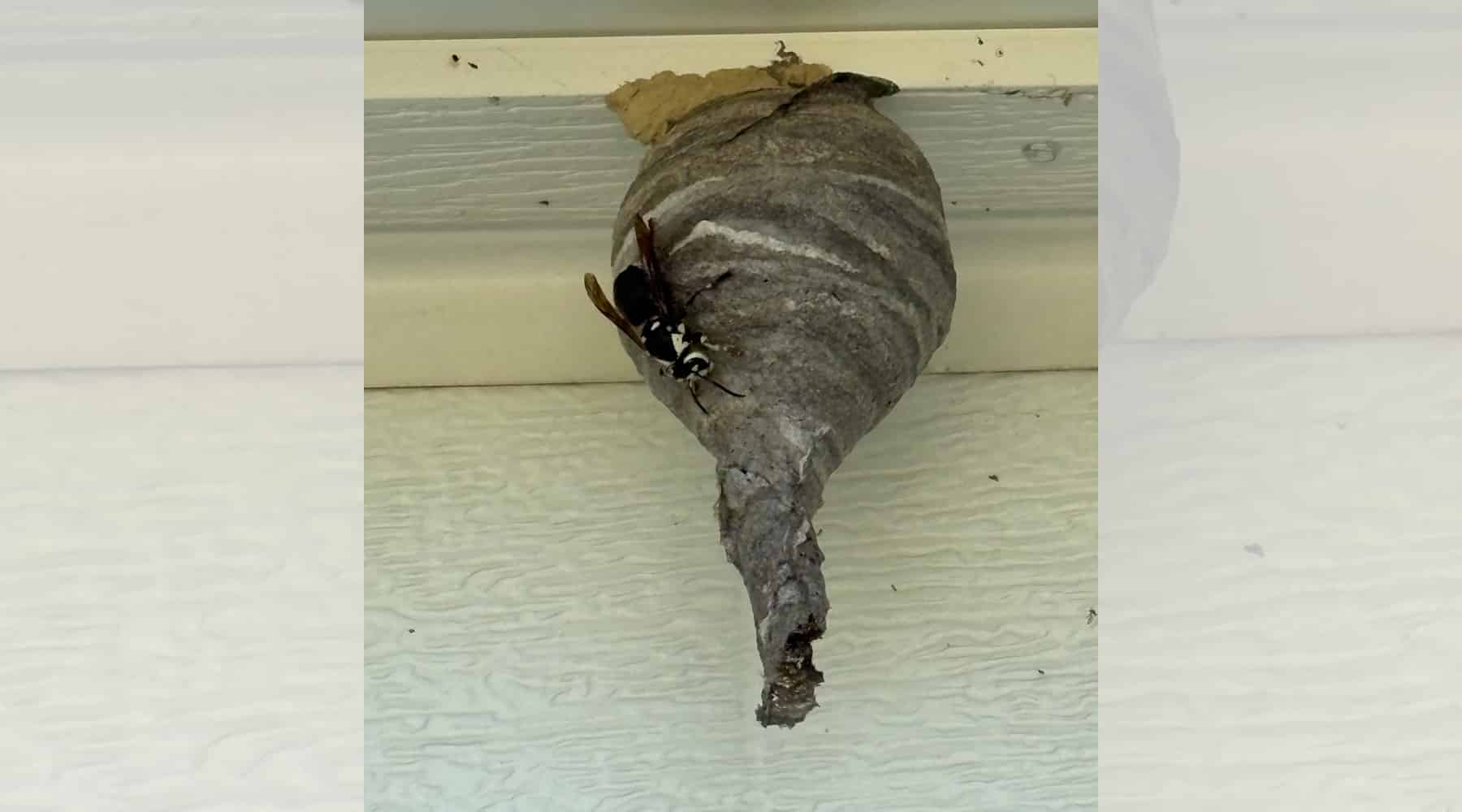

If you’ve ever come across one of those gray, papery hornet nests hanging in a tree line or tucked under the overhang of your home, you probably know the first rule: don’t poke it, don’t shake it. Those are baldfaced hornet nests, and they earn a wide berth for good reason. They sting when they feel they are under threat.
Last week, I had several emails asking about their control. All these nests were being built on the sides of buildings. The stealthier nests are being constructed in bushes and trees a few feet off the ground, only to be discovered later in the summer.
What we tend to forget is that these insects are not just flying troublemakers. Baldfaced hornets actually do a fair bit of work for us, whether we notice or not. They’re hunters, picking off flies, caterpillars, and other soft-bodied insects that can do real damage to gardens and crops. They also end up moving pollen around while they’re at it, even if that’s not the job description we usually assign them.
From our point of view, a nest showing up over the mailbox or near the back door feels like an intrusion. But if you come across one in winter, after the leaves are down, it usually tells a different story. It means the whole long summer passed without a major conflict between people and wasps. You both stayed in your lanes and got on with it.
By midsummer, these wasps can get a little short-tempered. Not all the time, but enough that most folks who work outdoors learn to keep an eye out when mowing, trimming, or trimming hedgerows. The nests usually show up in shrubs or trees, sometimes at eye level but often well above your head—30 feet or more at times.
Their lives are short, intense, and entirely tied to the colony. The workers are all female, and they don’t get a second act—no reproduction, no retirement. Just building and defending the nest, feeding the young, and keeping the whole operation running. Only the queens and males take part in the late-season mating flights. After that, new queens scatter to find winter shelter, sometimes slipping into rotten logs or tucked-away crevices.
The rest of the colony doesn’t make it through winter. Once cold settles in, the workers die off and the nest is left behind, hanging like an abandoned balloon. Winter wind and snow eventually knock it loose, and it drops to the ground in pieces.
The nests are impressive structures when you see them up close. Oval, layered, sometimes nearly two feet long by fall, built around branches or tucked into the framework of whatever they’ve chosen as a foundation. There’s usually a single entrance hole down low, like a guarded doorway.
The construction is pure instinct. Workers chew up wood fibers, bark, leaves, and whatever else is handy—even scraps of paper if they find it—and mix it with saliva to make a kind of pulp. That material gets molded into thin layers that dry into the familiar papery shell. The swirls and stripes people often admire aren’t decoration; they’re just the natural variation of whatever plant material went into that particular batch.
Inside, the real work happens in stacked combs—rows of cells where the queen lays eggs and the workers tend the developing larvae. Depending on the season and conditions, a single nest this time of the year may hold just a few dozen insects. By fall, the population can swell into the hundreds. For most folks, that’s not something they want to discover the hard way.
If you have a nest on the side of a home, or an inconvenient location along a walkway, it’s advisable to control it early. Most businesses that sell household insect sprays sell hornet and wasp spray cans that can shoot a stream from 25 feet away. This is best done in the cool of the evening. Save a third of the can for retreating in 7 days. There are always stragglers.
Nests that are 25 or more feet of the ground are rarely a threat. Most people do not even notice them until the leaves fall off.
By Jeff Burbrink, Purdue Extension LaGrange County
