
Midwesterners are all too familiar with scorching summers. While midsummer doesn’t offer the vivid floral displays of spring shrubs, great options are available, said University of Missouri Extension horticulturist David Trinklein.
Gardeners willing to embrace a more subtle look can choose from several tough, drought-tolerant shrubs that continue to bloom beautifully despite the heat.
Rose of Sharon
One such shrub is rose of Sharon (Hibiscus syriacus), a hardy member of the hibiscus family. Achieving a mature height of 6-10 feet, it provides summer color in shrub borders or screens. Cultivars are available with purple, violet, red, pink or white flowers. Rose of Sharon is a resilient, low-maintenance flowering shrub renowned for stunning blossoms that provide vibrant color during the late summer when most garden blooms have faded.
Japanese spirea
Japanese spirea (Spiraea japonica) and hybrids of it are also tough, summer-blooming shrubs. They are a colorful, low-maintenance landscape favorite. Known for its stunning, mounded habit, this deciduous shrub dazzles with flat-topped clusters of pink or white blossoms.
It also boasts gorgeous, color-shifting foliage that transitions from fiery bronze in spring to vibrant hues in autumn. It has a mounded growth habit to a height of around 4 feet.
‘Shirobana’ is a noteworthy cultivar that has flowers that range from white to pink to deep rose in color. ‘Little Princess’ produces light pink flowers over low, mounded mint green foliage.
Bumwald spirea
Bumald spirea (Spiraea x bumalda) is a cross between Spirea japonica and Spiraea albiflora. This exceptional, multiseason shrub is celebrated for its dramatic foliage. Emerging with warm-toned hues in spring, it dazzles into summer with flat-topped clusters of pink or carmine blooms. This highly adaptable, low-maintenance shrub brings continuous charm and butterfly-attracting color to the garden. It grows only 2-3 feet tall.
There are more than 20 named cultivars of bumald spirea. The oldest and perhaps most popular is ‘Anthony Waterer,’ which flowers throughout the summer, producing pinkish-red flowers over deep reddish-purple foliage. Other noteworthy cultivars include ‘Goldflame’ and ‘Gold Mound.’ Both have golden yellow foliage that contrasts nicely with their pink flowers.
Although not a true spirea, Blue Mist spirea (Caryopteris x clandonensis ‘Blue Mist’) also produces nice color in the heat of summer. This hybrid caryopteris produces fragrant, purple-blue flower spikes over grey-green foliage. The flowers are attractive to butterflies, bees and other beneficial insects. Plants are bushy and may grow 2-3 feet tall. Flowers are produced on new (current year’s) wood. So even if a severe winter should kill back much of the top, it will come out in the spring and flower that summer.
Vitex
Another shrub that produces blue flowers in late summer is vitex (Vitex agnus-castus). Also known as chaste tree, vitex is a remarkably resilient, heat-tolerant marvel. It has stunning, lavender-blue summer spikes and deeply aromatic, star-shaped foliage that reaches up to 15 feet in height.
This robust shrub is a magnet for pollinators while requiring remarkably little attention. It is reliably winter-hardy only through Zone 6; farther north, it often is killed back to the ground each winter and grows only 3-5 feet the following summer.
Buddleia
Staying with the color blue, buddleia (Buddleia davidii), widely known as the butterfly bush, is an attractive, low-maintenance shrub with cascading, honey-scented spikes bursting with saturated colors that draw graceful pollinators to the garden. The species grows 6 feet or more in height. However, hybrids derived from the species have the advantage of being more compact in growth habit, more floriferous and nearly sterile.
For example, the Pugster series bears large flower trusses on plants that achieve a height of only about 2 feet. Most hybrid buddleias come in a variety of colors, including blue, lilac, pink and white.
Potentilla
For gardeners who want yellow summer flowers on durable shrubs, potentilla (Potentilla fruticosa) might be the answer. This shrub bears buttercup yellow flowers on low, mounded plants that average about 2-3 feet in height. Potentilla is an excellent choice for dry, sunny areas. Flowers normally are produced in June and continue through frost. There are cultivars available in other colors, although the yellow ones, such as ‘Goldfinger,’ are the most characteristic this species.
Crape myrtle
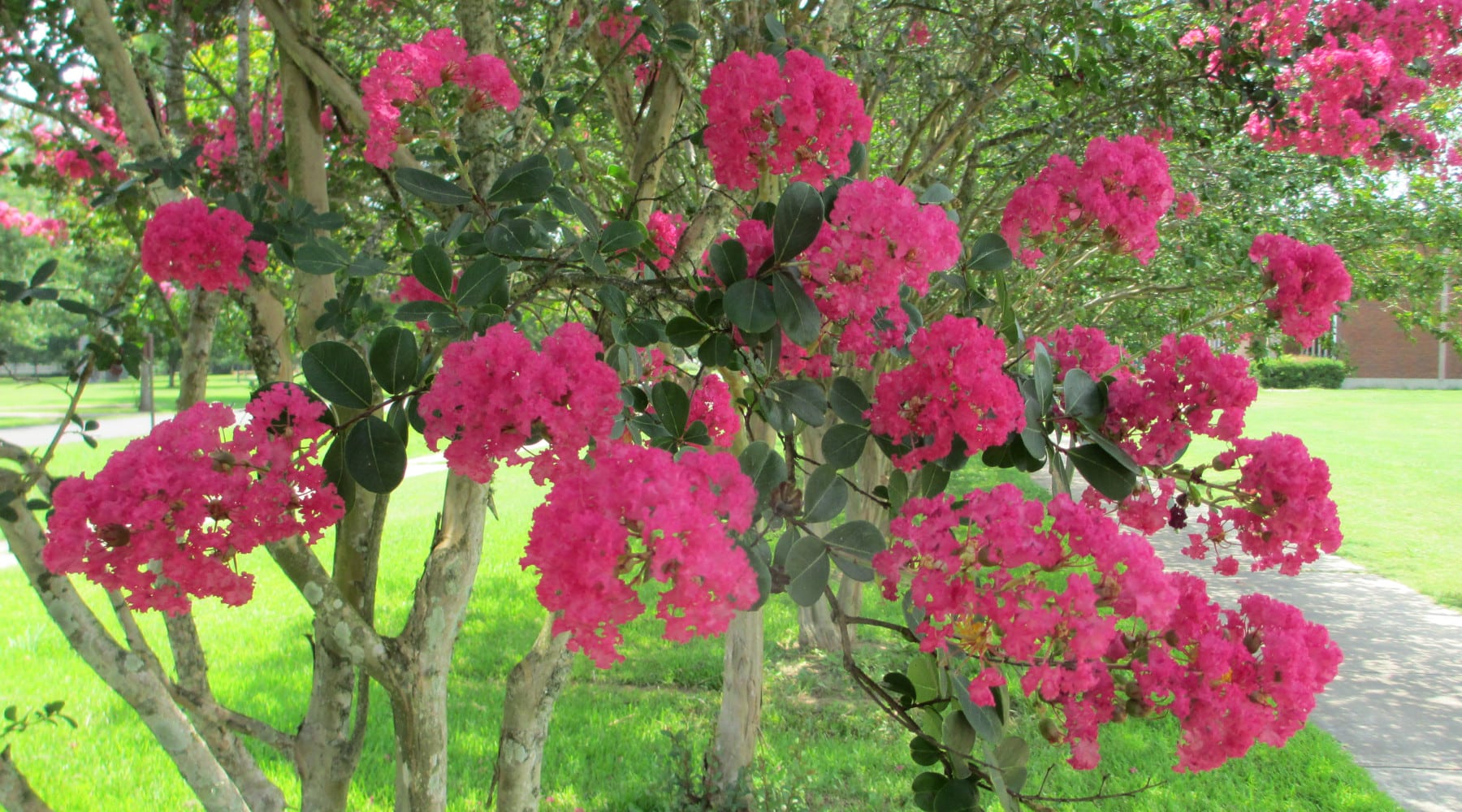
Finally, for excellent summer-through-autumn color, few shrubs can match crape myrtle (Lagerstroemia indica). Often dubbed the “lilac of the South,” crepe myrtle is an elegant ornamental shrub that delivers spectacular beauty. Famous for its crinkled, paper-like summer blossoms and smooth, exfoliating bark, it is a remarkably resilient, low-maintenance centerpiece for any garden or landscape. In addition to red and rose, hybrid cultivars have expanded the color range to include white, pink, mauve, lavender and purple.
Additionally, some cultivars bear flowers that are pleasantly fragrant. ‘Natchez,’ which was developed by the U.S. National Arboretum, is a popular cultivar, as is ‘Dynamite,’ which is renowned for its deep red flowers.
By Linda Geist, University of Missouri Extension
