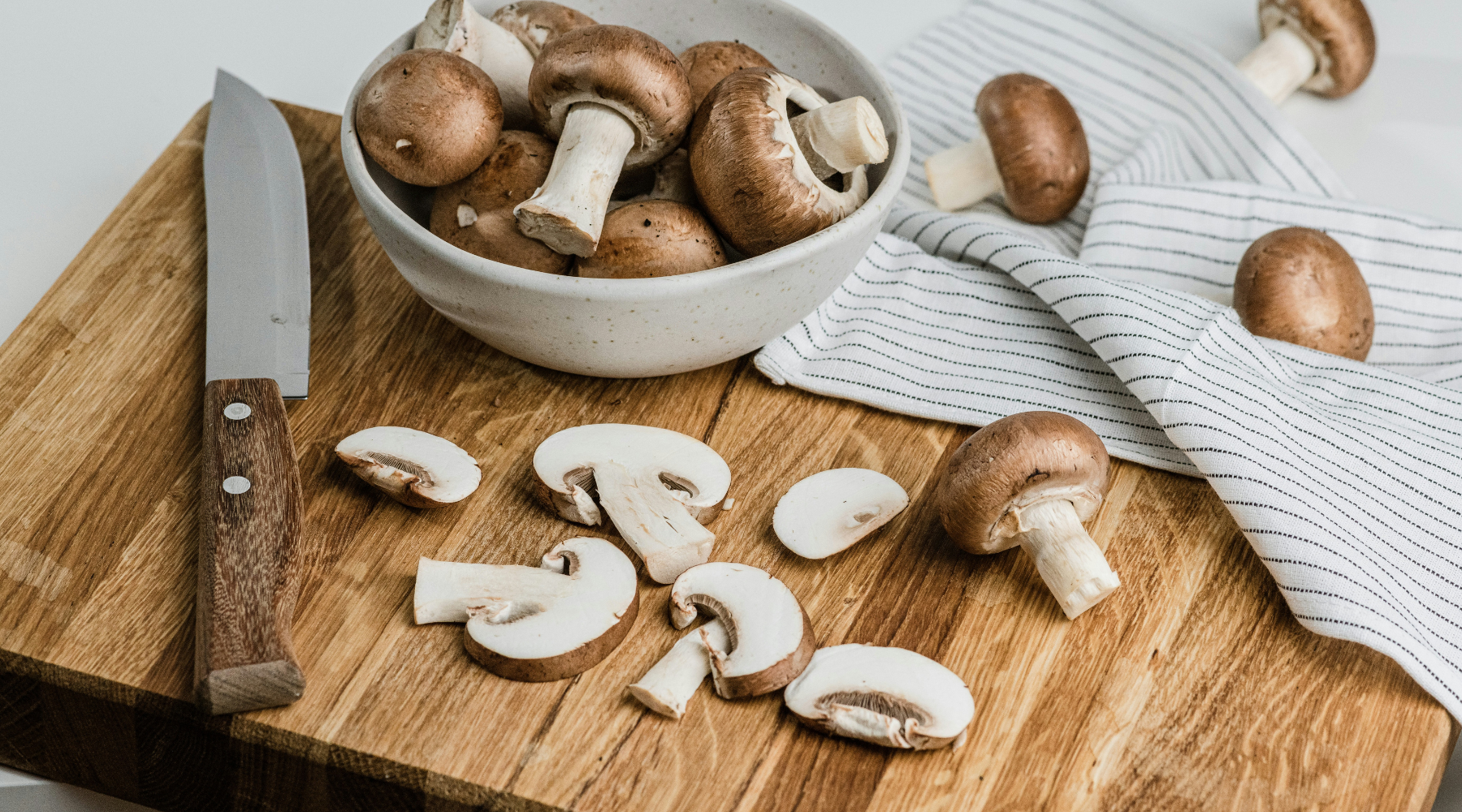

In the past, mushroom farmers have relied heavily on manual labour for their farming practices. However, local startup Mycro Harvest has changed the landscape of mushroom farming by using AI in the growing process.
Officially founded in Toronto by Christopher Klich and Justin Cheng, the startup joined the University of Waterloo’s Velocity incubator in mid-2023 to scale its AI-driven gourmet mushroom farms in shipping containers.
“It’s a little bit like speed dating, where entrepreneurs come together, and they try to find a co-founder and find a problem that we are both uniquely suited to solve together, rather than the alternative of someone coming with a problem in mind and trying to make their skill sets fit,” explained Cheng, now the CEO and chief technology officer of the company.
For Cheng, mushrooms were always a topic of interest.
“I already had a latent interest in mushrooms from a biology standpoint,” he said.
“I’ve foraged for them in the past. I’ve grown gourmet mushrooms at home, and that kind of just pulled the string that we decided to look into.”
After looking into the state of mushroom farming in Canada and the United States, Cheng realized how antiquated the industry was, with many farms in the United States aged between 60 and 100 years.
“They [United States] are still growing out of two-by-four bed frames and everything. We’re a little more advanced here in Canada, but ultimately, the opportunity we saw was how finicky the process is, and how much farming operations rely on what they call master growers for a key operation,” explained Cheng.
Master growers are a vital component of Canada’s mushroom growing industry. They manage complex, year-round controlled environments across major growing hubs like Ontario and British Columbia.
“Those are the people that are in charge of the crop, in charge of making decisions on how to manage the environment in the grow rooms, like humidity, temperature, airflow, those kinds of things. A good master grower, we found, could make a huge impact on yield just by knowing how to treat the mushrooms and knowing what they need when by looking at whether they’re short on airflow whether they’re not getting enough light that kind of thing and seeing that problem and diving deeper into it.”
While master growers are integral to mushroom farming operations, they are also in short supply.
“It takes a lifetime of working with the crop to be able to amass the knowledge they need to be able to make those informed decisions and actually improve yield, and it’s not even just improving yield. It’s having a consistent growth operation, because that’s the other side of the coin that I mentioned. Mushrooms are just very, very finicky to grow,” he said.
Mushrooms’ quick growth makes it imperative for master growers to closely watch the fungi. Unlike field crops, mushrooms take, on average, only 14 days to go from ground zero to harvest-ready.
“In 14 days, they’re doubling in size every 24 hours. So, you really need to be extremely reactive. In some cases, some of the farms we saw would send people to the farm at midnight just to check on the mushrooms, so it’s a 24-hour monitoring problem, and it’s a high-skill problem, and that kind of suits itself well to the system we’ve developed,” Cheng said.
Mycro Harvest’s system uses AI as a master grower, deploying the Internet of Things (IoT), a vast network of physical objects, such as appliances, vehicles, and machines, embedded with sensors, software, and connectivity that enable them to collect and share data and closely monitor the mushrooms.
For the mushroom-growing operation, the system distributes smart sensors throughout the grow room to monitor the environment and track mushroom growth, including AI-driven climate control.
“We feed that data into our backend platform, where we teach our machine learning algorithms what is required to make a mushroom grow to its highest potential,” said Cheng, noting that so far, the results are extremely promising when comparing AI to a master grower.
One of the main benefits of using AI to monitor mushrooms is continuous oversight. A human master grower has to take breaks and is limited by how much they manage themselves. By contrast, an AI does not need breaks and can monitor for 24 hours.
“These mushroom farms often have dozens, if not hundreds of grow rooms, where they’re broken into separate, different species, different areas to try and contain contamination,” said Cheng.
“You can imagine a master grower, if he wants to manage a big farm, has to go into 80 different rooms every day, recall how the mushroom looked yesterday, and how they’re proceeding through their growth, so it becomes a management and bandwidth task as well for human growers, whereas our AI has a perfect recollection of where the mushroom is throughout the entire growth stage.”
Mycro Harvest focuses specifically on growing gourmet mushrooms such as shiitake, oyster and lion’s mane. Their agricultural technology is also designed to reduce waste and have lower energy usage.
Most of the mushrooms grow in a hardwood sawdust substrate, a byproduct of sawmills processing trees such as oak, maple, beech and birch.
“The byproduct of growing mushrooms is also a really valuable fertilizer to use to grow plants. So, it’s kind of a beautiful closed-loop system,” said Cheng.
One of the challenges when first introducing the technology for Cheng was making it accessible to farmers who might not have as much technological experience.
“Making sure that we’re building something that is providing actionable value to farmers was a big hurdle that a lot of startups miss. I think they build the technology that they want. They think it is going to make a big impact, [but they’re] not necessarily working extremely closely with farmers to be able to build something that fits into their workflow and they can leverage immediately,” said Cheng.
“When we started the company, we were sleeping on farms, working with the farmers every day, being a part of their operation. Also, making sure that we had a very intimate understanding of how the entire process works and what tools, and allowing us to identify opportunities for improvement.”
So far, the company’s focus has been on the Ontario mushroom market. For more information, visit mycroharvest.com.
By Meg Deak, Canadian Press Via Associated Press
