
If you’ve spent much time around regenerative agriculture, you’ve probably heard the term compost tea.
But what exactly is it? Why would a farmer put compost into water and then apply that water to the soil? And what does it have to do with the billions of microorganisms living beneath our feet?
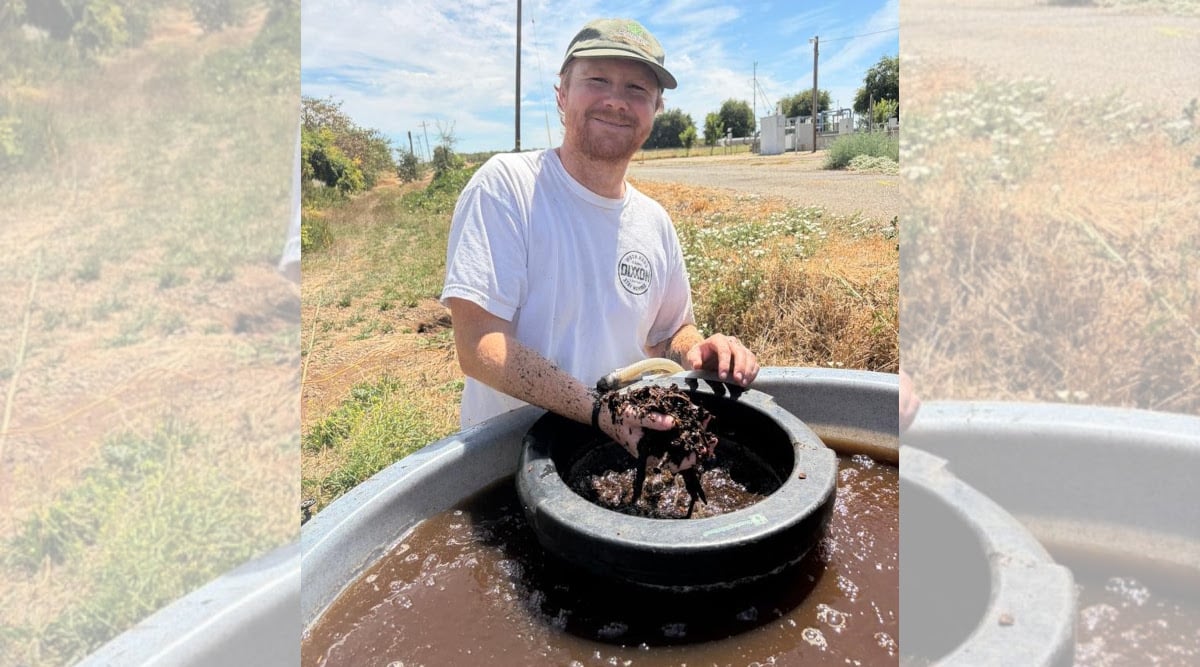
We took a closer look at the process at the Chico State University Farm with Declan Ramsay-Malone, a master’s student in regenerative agriculture and an intern working with the Farm’s organic vegetable unit.
The answer starts with the compost itself.
It all starts with healthy compost
High-quality compost isn’t simply a pile of organic material that has decomposed. It is a living ecosystem filled with bacteria, fungi and other microscopic organisms that play important roles in the soil food web.
At the Chico State University Farm, the composting process is carefully managed.
The compost pile contains a balance of materials, including nitrogen-rich “greens” and carbon-rich “browns.” The pile is turned in a specific way to make sure the material reaches the temperatures necessary to address potential pathogens and weed seeds.
Temperature and time are important.
For example, Ramsay-Malone describes how he monitors the pile to reach approximately:
- 160°F for 24 hours
- 150°F for 48 hours
- 130°F for 72 hours
Once the heating cycle is complete, the compost enters an aging process. The pile is protected from direct sun, wind and rain, while moisture is carefully monitored.
The result is finished compost rich in microbial life.
So, what is compost tea?
In simple terms, compost tea uses water to extract microorganisms and other compounds from finished compost. Depending on how it is prepared, the process may also encourage those microorganisms to multiply.
At the Chico State University Farm, finished compost is placed into a brewer filled with water. Air bubbles agitate the water and compost, helping microorganisms move from the organic material into the water.
The resulting liquid can then be applied to the soil.
Compost tea vs. compost extract
There is an important distinction in what is happening at the Farm.
A traditional compost tea is generally brewed with an additional food source intended to encourage microbial growth during the brewing process.
What the Farm demonstrates is technically a compost extract. No additional food source is added. Instead, the process uses water and agitation to knock microorganisms from the finished compost into the water.
That extract can then be used as a soil drench or applied through irrigation.
Why soil biology matters
Think of soil as more than dirt.
Healthy soil contains an incredibly complex community of bacteria, fungi, protozoa, nematodes and other organisms. Together, these organisms form what is often called the soil food web.
At the CSU Chico Farm, the goal isn’t simply to add nutrients to the soil. It’s to support the biological community already at work there—particularly fungal activity.
Fungi and other soil organisms contribute to processes that are important for healthy soil, including decomposition and nutrient cycling. Soil organisms can also contribute to soil aggregation and structure, which in turn can influence water infiltration and water-holding capacity.
Applying compost extract is one way the Farm is exploring how microbial communities can be supported and introduced into the soil.
From brewer to field
Once the finished compost is ready, the extraction process is relatively simple.
First, water is added to the brewer. Because the Farm uses city water containing chlorine, the water is aerated before the compost is added. This allows chlorine to off-gas, creating a more suitable environment for the microorganisms being introduced.
Finished compost is then placed into the brewer. Air bubbles continuously agitate the water and compost, helping microorganisms detach from the organic matter and move into the water.
After the extraction process is complete, the remaining organic material goes back into the compost pile rather than being discarded—a simple example of closing the loop.
The finished extract can then be applied through the Farm’s irrigation system. A submersible pump moves the extract through irrigation lines and out to the crops.
This makes it possible to incorporate the biological amendment into the Farm’s existing irrigation practices rather than requiring a separate application method.
The Farm takes particular interest in applying the extract after soil disturbance, including tillage, when appropriate. It can also be applied while crops are actively growing.
One practical consideration is filtration. Small pieces of organic material can make their way into the extract and potentially clog irrigation equipment, so the Farm pays attention to sediment and debris before sending it through drip tape.
It’s about building soil, not just feeding plants
Perhaps the most interesting part of compost extract is the philosophy behind it.
Conventional fertilizers are generally designed to deliver specific nutrients directly to plants. Compost and biological amendments take a different approach.
Instead of simply asking, “What nutrients does this plant need?” regenerative agriculture also asks:
“What can we do to support the living system in the soil?”
That means paying attention to the organisms that help cycle nutrients, decompose organic matter and contribute to a functioning soil ecosystem.
Compost extract is one tool the Chico State University Farm is using as part of that larger approach.
And it all begins with something remarkably simple: healthy, biologically active compost.
Want to see the process?
Watch Declan Ramsay Malone walk through the compost piles, demonstrate the compost brewer and show how the finished extract is applied to crops at the CSU Chico Farm.
Because sometimes the best way to understand healthy soil is to start by looking at what’s happening beneath the surface.
By Nicole Johansson, Chico State Center for Regenerative Agriculture & Resilient Systems
